The choice of finger for wearing a ring rarely depends on a single consideration. Inherited symbolism, daily comfort, hand morphology, current trends: several parameters overlap, and the answers vary according to cultures and eras. Rather than listing each finger (which has already been extensively covered elsewhere), this article focuses on the concrete criteria that truly guide the decision.
Biomechanical comfort: not all fingers are equal for wearing a ring
Online guides mention comfort vaguely, without distinguishing the mechanical constraints specific to each finger. The index and thumb are the fingers most used in gripping actions. A bulky ring on the index can hinder writing, tool handling, or prolonged use of a keyboard.
The middle finger, being the longest, supports wide rings well but can sometimes limit the full flexion of the neighboring finger if the jewelry extends laterally. The ring finger remains the least mechanically stressed finger, which partly explains why it traditionally hosts the wedding band.
The pinky, often chosen for signet rings, poses another problem: its small size makes sizing more delicate. A ring that is slightly too wide turns constantly, and a ring that is too tight causes quick discomfort in case of heat or water retention.
Before wondering what a finger “means,” it is useful to check three practical points:
- The ring passes over the joint without forcing but does not slide freely once in place at the base of the finger.
- The width of the band does not compress the neighboring finger when the hand is closed.
- The decoration or stone remains oriented upwards during the usual movements of the hand.
By following the advice from Madame Pervenche on wearing a ring, we find this logic of comfort as the primary filter for selection, before any aesthetic or symbolic consideration.
Ring on the ring finger or index finger: what the symbolism really says
The symbolism of rings dates back to antiquity. The Romans reserved the left ring finger for valuable rings, convinced that a vein (the “vena amoris”) connected this finger to the heart. This anatomical belief is false, but the cultural convention endures in most Western countries.
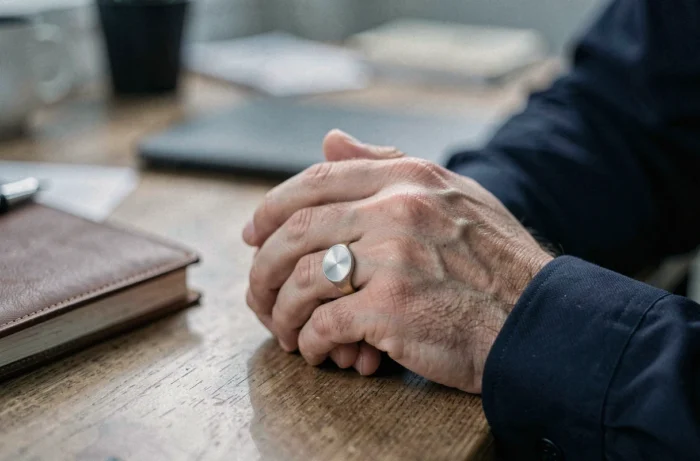
The index finger has long been associated with authority. Ecclesiastical and royal seals were worn on it during the Middle Ages. Today, this finger willingly hosts bold rings, models with visible stones, or designer pieces that one wishes to highlight.
Left hand or right hand for the wedding band
The dominant convention in France places the wedding band on the left ring finger. In Germany, Russia, or Norway, the right hand prevails. The choice of hand depends more on the country than on a universal rule. No standard imposes itself beyond local custom.
For rings not related to marriage, the left/right distinction has no established meaning. Field reports vary on this point: some esoteric traditions attribute a meaning to the receiving hand (left) and the active hand (right), but these interpretations are not based on any consensually documented foundation.
Ring stacking and maximalist trend: the question of a single finger becomes obsolete
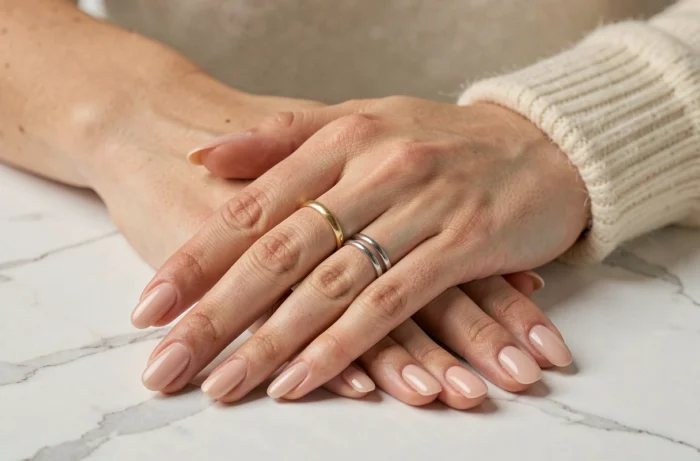
The fashion trend observed for several seasons challenges the very logic of the “right finger.” Ring stacking (the layering of thin rings on one finger or across several fingers simultaneously) has become a common practice, especially in European fashion.
Media like Vogue NL describe a marked return to maximalism, where the composition across multiple fingers replaces the choice of a single finger. The entire hand becomes a canvas for expression, with thin rings stacked on the index, middle, and ring fingers at the same time.
This approach changes the initial question. Rather than “which finger to choose,” the reflection becomes “how to visually balance the hand.” A few practical guidelines help structure the composition:
- Alternate thin rings and wider rings to create contrast without overloading a single finger.
- Keep at least one finger free (often the thumb or middle finger) to maintain the readability of the whole.
- Favor a consistent metal (gold, silver) on the same hand, or embrace a deliberate mix with closely styled pieces.
Ring size and hand morphology: often overlooked criteria
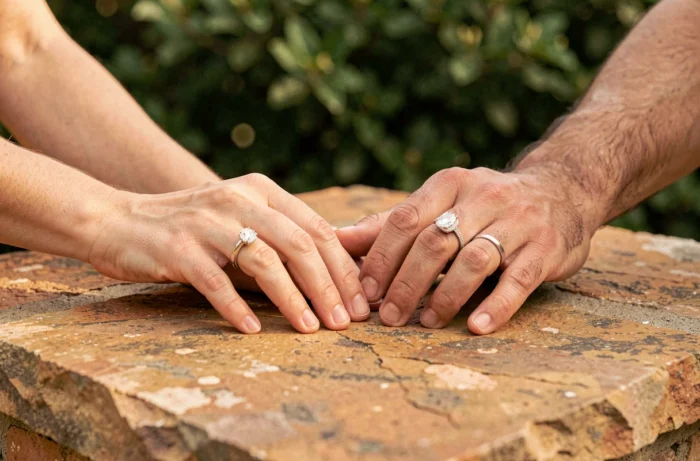
The morphology of the hand strongly influences the appearance of a ring. A wide band is better suited for long, slender fingers, while a thin, delicate ring highlights shorter fingers without visually weighing them down.
The ring size itself fluctuates throughout the day. Heat, physical exertion, and water retention related to the hormonal cycle in women: all these factors measurably alter the diameter of the finger. A ring that fits in the morning may feel tight by the end of the day.
Choosing the right size according to the finger
The most reliable method remains to try the ring at the end of the day when the fingers are slightly more swollen. The jewelry should slide over the joint with slight resistance, then stay in place without turning freely.
For those who hesitate between two fingers, testing the wear over several days allows for checking real comfort in daily movements. A ring worn on the weekend is not enough: it is at work, during sports, or in the kitchen that the limits appear.
The “ideal” finger for wearing a ring does not exist outside of a personal context. Symbolic conventions provide a cultural framework, biomechanical comfort sets practical limits, and current trends largely free the choice. The only rule that withstands scrutiny: a well-worn ring is one that you forget you are wearing.