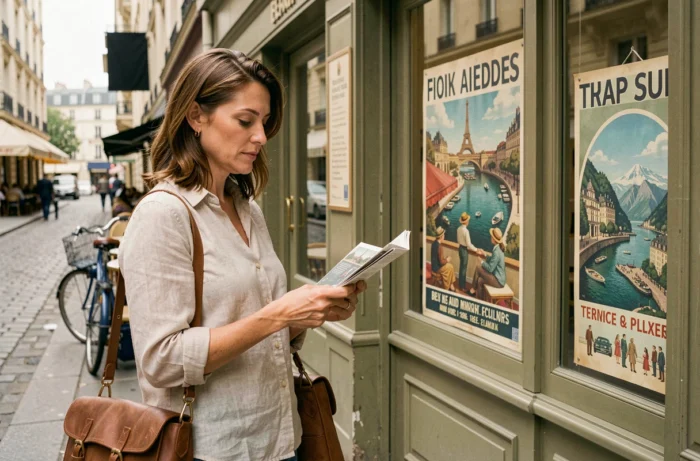
We’re planning a stay in the Luberon, torn between a tour of Brittany and a week in Corsica, and when it’s time to book, we have three tabs open: an online platform, a package tour operator and a local travel agency. Choosing a travel agency for a holiday in France comes down to practical criteria that most comparison guides fail to rank. Here’s how to narrow down your options effectively.
Atout France registration and financial guarantee: the first screening step
Before comparing destinations or prices, check one regulatory requirement that immediately rules out less reliable operators. The public Atout France register lets you verify the registration of any travel seller in just a few seconds. Registration requires professional liability insurance and a financial guarantee to protect the money you’ve paid if the operator fails.
The financial guarantee may provide for a refund or an alternative stay. This isn’t an optional quality label: it’s a legal requirement. If the agency you’re considering doesn’t appear in the register, look elsewhere, no matter how appealing its catalogue may be.
Another often-overlooked point is mediation. The Tourism and Travel Mediator exists, but membership is not mandatory for all professionals. Check the terms and conditions of sale to see whether a mediator is named. If a dispute arises over a stay in France (cancellation, service not as described), this information can make a real difference to your options.
On agence-voyage-tourisme.com, the listings for featured agencies let you cross-check this information before getting in touch.
Online agency, high-street branch or specialist: choose based on your stay in France

The DGCCRF (France’s consumer protection authority) points out that a platform selling a package holiday must follow the same rules as a high-street agency. The sales channel does not determine the level of legal protection. What changes is the type of support you receive.
High-street agency with a dedicated travel adviser
For a tailor-made tour of France (a wine route through Burgundy, or a hike in the Pyrenees with overnight stays in guesthouses), an adviser who knows the area can save you time. Ask specific questions: how busy it gets in peak season, alternatives to overcrowded attractions, access restrictions. If the adviser can’t answer questions about the destination without consulting a catalogue, their claimed expertise is superficial.
Online platform and package tour operator
For a standard beach holiday (a resort on the Mediterranean, or a seaside rental), online offers make it easy to compare prices quickly. Customer service varies considerably from one operator to another. Ask a question by phone or chat before booking: the response time and quality reveal the actual level of service.
Specialist agency
A cycling holiday along the Loire, a wine-tasting break in Alsace, or an accessible trip for someone with reduced mobility: specialist agencies put together itineraries that generalists don’t offer. Their range is narrower, but their in-depth knowledge of their niche more than makes up for it.
Package holidays and traveller protection: what the contract must include
The distinction between individual services and a package holiday has a direct impact on your rights. A package combines at least two types of service (transport, accommodation, activities) sold for one total price. In this case, the travel agency is fully liable for the entire stay.
A package holiday offers better protection than a simple hotel booking. If you book a train and a guesthouse separately through two different websites, no one coordinates things if a problem arises. With a package, the agency is your single point of contact for any issues.
Before signing, check that the contract specifies:
- Details of the services included (accommodation, meals, transfers, excursions), including the names of providers where known
- Cancellation and amendment terms, including any fees charged depending on how far in advance you cancel
- The name of the financial guarantor and the contact details of the appointed mediator, if applicable
- How issues will be handled if services don’t match what was promised (different accommodation, cancelled activity)
A contract that is vague on these points is a warning sign, not an administrative detail.

Comparing travel agencies: the criteria that really set them apart
Online customer reviews give you a general sense, but they aren’t enough to assess an agency for a holiday in France. Two practical criteria can help you distinguish the serious contenders.
First: how quickly they respond if something goes wrong during your stay. Ask the agency what happens if your accommodation is unavailable when you arrive, or if a booked activity is cancelled due to the weather. An agency that explains a clear procedure (emergency number, pre-identified replacement provider) inspires more confidence than one that promises “everything will be fine”.
Second: price transparency. Compare the total price, not the headline price. Some offers advertise an attractive rate that excludes transfers, tourist taxes or insurance. Ask for an itemised quote and compare each line. The difference between two agencies may come down to booking fees or extras that only appear at checkout.
Your choice of agency also depends on how much customisation you want. For a tailor-made stay, your initial conversations with the adviser matter just as much as the catalogue. The questions they ask about your preferences (pace of travel, type of dining, interests) show whether they’re building a trip around you or simply filling in a standard template.
Choosing a travel agency for a holiday in France means weighing up price, the depth of advice and the strength of the guarantees. The Atout France register is the place to start, the package holiday contract is your legal foundation, and the quality of your conversation with the adviser is the final reliable indicator.