
We prepare for a trip, we return, and two weeks later, we are already looking for tickets to another destination. This repetitive pattern has a name borrowed from German: wanderlust, a contraction of wandern (to travel, to wander) and lust (desire, aspiration). Behind this term lies a need for movement that goes beyond the simple desire for a vacation, and whose mechanisms touch on both neurobiology and digital habits.
Wanderlust and dopamine: what happens in the brain before departure
When we book a ticket or browse photos of landscapes, the reward circuit activates. Dopamine, a neurotransmitter linked to the anticipation of pleasure, rises even before the trip begins. It is this mechanism that makes the planning phase almost as stimulating as the trip itself.
Several popular articles attribute this phenomenon to a variant of the DRD4 gene, nicknamed the “travel gene.” The reality is more cautious: the associations between dopaminergic variants and personality traits remain poorly supported and have not been independently replicated. One can retain the idea of an individual sensitivity to novelty, without making it a genetic fatality.
What varies from person to person is the threshold of stimulation needed to feel satisfaction. Some people need familiar contexts, while others find their balance in frequently changing environments. Wanderlust is situated at the extreme end of this spectrum, where routine becomes more of a discomfort than a reference point.
To delve deeper into the wanderlust syndrome on 123 Voyages, you will find a comprehensive overview of these mechanisms and their daily translation.
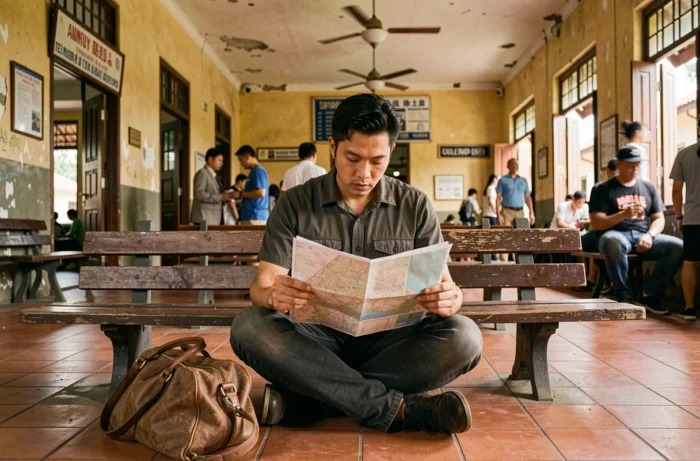
Desire to travel: the role of screens and digital anticipation
The irresistible need to leave does not arise solely from a personality trait. The desire to travel can be built through digital anticipation, even before departure. Social networks, immersive videos, airline newsletters: we are exposed to a constant flow of content that activates the same dopaminergic circuit as planning a real trip.
This phenomenon has been documented in the field of online tourism behavior. Repeated exposure to travel content creates a loop: we watch, we imagine leaving, dopamine rises, and the longing sets in when we close the screen. It is a mechanism of appetite maintained by the digital environment, not just by personality.
In practice, we can observe this cycle in people who had no particular passion for travel before becoming active on certain platforms. The desire to leave is learned as much as it is felt. This observation nuances the romantic image of the wanderluster as a “born traveler.”
Wanderlust syndrome: a real disorder or an accepted lifestyle?
The word “syndrome” poses a problem. There is no trace of wanderlust in clinical psychology textbooks. The term circulates more in anthropology or genetics literature to describe a behavioral tendency, not a medical diagnosis.
The distinction matters. To label someone as “sick of travel” is to pathologize a behavior that, in most cases, remains perfectly functional. We are talking here about a marked preference for mobility, not a destructive compulsion.
Where nuance is necessary is when the need to leave interferes with concrete commitments: stable employment, lasting relationships, financial health. The signals to watch for do not come from an online test, but from a measurable gap between aspirations and constraints.
- Booking a trip while not having financially settled the previous one, repeatedly
- Feeling marked anxiety after a few days of routine, to the point of being unable to concentrate
- Organizing one’s entire life (housing, work, relationships) around the next destination, without a margin of stability
Wanderlust becomes problematic when it functions as an escape, not as a choice. As long as departure remains a weighed decision, we are in the realm of lifestyle, not disorder.

Traveling often: real impact on modes of transportation
The desire to discover the world faces logistical and environmental realities. According to Eurostat, trains surpassed buses and coaches in passenger travel distribution in the European Union in 2024, for the first time since 2014. The car remains dominant, and the share of air travel has increased over the observed decade.
In other words, wanderlust does not automatically translate into less polluting transportation choices. One can feel a deep need to discover new cultures and places while flying by default due to a lack of practical or affordable alternatives.
For frequent travelers, the choice of transportation becomes a constant trade-off:
- Trains offer a complete travel experience (scenery, flexibility, low carbon footprint) but are limited for distant destinations
- Low-cost flights fuel the cycle of wanderlust by making tickets accessible, but with a disproportionate environmental cost on short trips
- Carpooling and camper vans appeal to a segment of wanderlusters who seek both the journey and the destination
The choice of transport shapes the experience as much as the destination itself. A night train journey to Italy and a direct flight to the same city do not produce the same trip, nor the same memory.
Living with the constant desire to leave
One does not “cure” wanderlust, and there is nothing to cure. What changes is the way we integrate this need for movement into a life that also has attachments. Some adopt remote work to travel without sacrificing their income. Others concentrate their departures on specific periods and invest the rest of the time in preparation.
The most common trap remains confusing the desire to leave with chronic dissatisfaction. Exploring new cultures enriches, but does not replace personal anchoring. Wanderlust works better as a driver than as an escape.