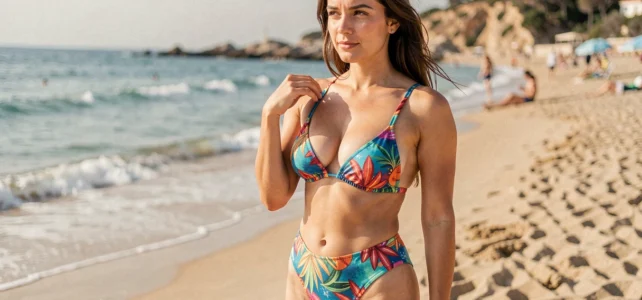
The too-small bikini is everywhere on social media, worn as a bold style accessory. Recent collections multiply the micro-triangle cuts and Brazilian cuts, but consumer feedback paints a more nuanced picture. This article compares what the trend offers to what women actually express regarding comfort, support, and coverage.
Breast support and adjustable coverage: what the tests reveal
Comparative tests published on women’s swimsuits highlight a clear gap between the “micro” offer and functional expectations. Tops that are too small and compress the breasts cause neck and upper back pain, a point rarely addressed in purely fashion articles.
Among 25-40 year-olds, the demand is for adjustable straps, drawstrings, and additional ties that allow for coverage adjustments without sacrificing a high-cut design on the hips. The tension between minimal aesthetics and functional comfort is particularly expressed in this age group.
The phenomenon of a beautiful woman in a too-small bikini fuels visual trends, but consumer surveys conducted by sports and lingerie brands confirm a rise in expectations regarding support.
| Criterion | Micro/Triangle Bikini | Adjustable Coverage Bikini |
|---|---|---|
| Breast Support | Low, no underwire or reinforcement | Moderate to good (underwire, drawstrings) |
| Coverage | Minimal, fixed | Modifiable (ties, adjustable straps) |
| Long-term Comfort | Frequent pressure on neck and back | More balanced weight distribution |
| Hip Adjustment | High cut, little adjustment | High cut possible with side knots |
| Declared Target Audience | All body types (marketing) | Priority to medium to large bust sizes |
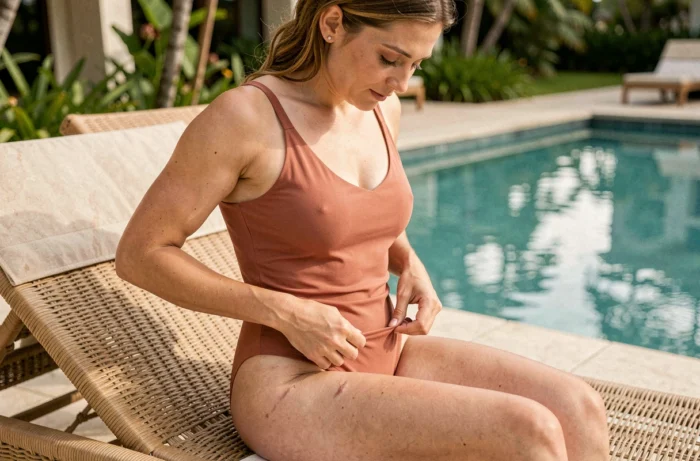
Too-small bikini and body shape: why bust size changes everything
The size of a bikini top is not just about the S, M, or L displayed on the label. The bust measurement and cup size determine real comfort, much more than the generic size. A triangle model without underwire suits an A or B cup, but visibly compresses from a C cup onward.
Feedback from tests on “curvy” swimsuits highlights a marked rejection of tops that are too small in favor of more enveloping cuts. Women with generous busts report two recurring issues:
- Thin straps that dig into the shoulders after an hour of wear, creating red marks and persistent discomfort.
- Insufficient fabric that causes lateral overflow, leading to discomfort and constant adjustments.
- The absence of an under-bust band that shifts all the weight of support to the neck, generating cervical tension.
Taking measurements (bust, under-bust, hip) before purchase remains the most reliable method. However, size guides vary significantly from one brand to another, complicating the process for online shopping.
Current regulations: bikini and public space in France
Wearing a too-small bikini raises not only a question of personal comfort. In France, several coastal municipalities penalize wearing swimsuits outside the beach. Cities like Nice or Cannes enforce municipal decrees prohibiting walking shirtless or in swimwear in the streets, with a fine of 35 euros at stake.
This regulatory framework applies equally to men and women. Swimwear, regardless of its size, is tolerated on the beach and by the pool, but not in urban spaces. The issue of the too-small bikini thus also involves a question of location.
Pools and campsites: specific restrictions on swimsuit types
Regarding French public pools, internal regulations often require fitted and non-floating swimsuits. Swim shorts are prohibited in most municipal pools. For women, some establishments refuse lace-up bikinis deemed unsuitable for swimming.
French campsites have also begun to specify in their regulations the types of swimsuits accepted around pools. These restrictions aim at hygiene and safety, not style, but they effectively limit the wearing of certain very high-cut models or those held by simple strings.
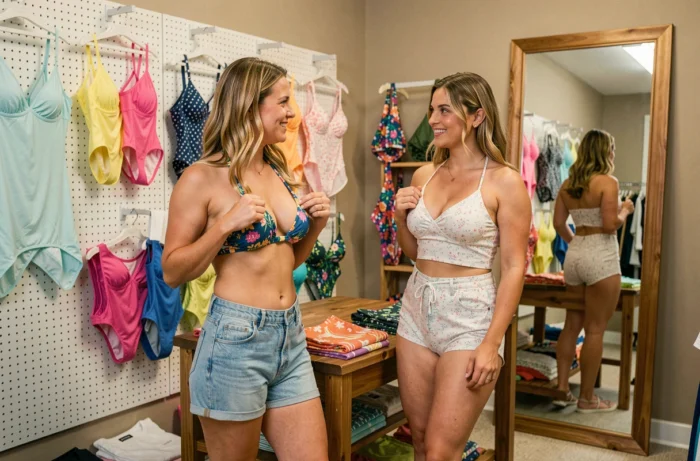
Choosing a bikini between style and comfort: the criteria that matter
The choice of a bikini should not be reduced to following a visual trend. Three technical criteria help distinguish an attractive model from one that is truly wearable:
- The support system: underwire, elastic band under the bust, or simple triangle. The larger the bust, the more structured support becomes necessary.
- The quality of the fabric: a sufficiently dense weight ensures that the swimsuit does not become transparent when wet, a common flaw in very thin models.
- The adjustment points: adjustable straps, side ties at the bottom, drawstrings at the neckline. Each adjustment point adds a margin of adaptation to the silhouette.
An adjustable model with side ties on the hips and modifiable straps offers the sought-after cut while adapting to movements. The Brazilian cut with adjustable knots illustrates this compromise: the silhouette remains defined, but comfort no longer depends on a fixed, one-size-fits-all approach.
The trend of the too-small bikini reflects a real aesthetic appeal, documented by search volumes and brand collections. Product return data and comparative tests show that the majority of women now prioritize adjustable support over a fixed minimal cut. The style is evolving towards models that reconcile cut and comfort, rather than a pure reduction of fabric surface area.