
We leave the Shiftech center with an optimized engine mapping, more responsive acceleration, and the satisfaction of having gained a few dozen horsepower. The problem arises three months later when an insurance expert connects their OBD scanner after an accident and finds that the ECU no longer matches the manufacturer’s data. Engine reprogramming at Shiftech raises a question that many drivers postpone until it’s too late: that of insurance coverage.
OBD Tools and ECU Logs: What the Expert Sees After an Incident
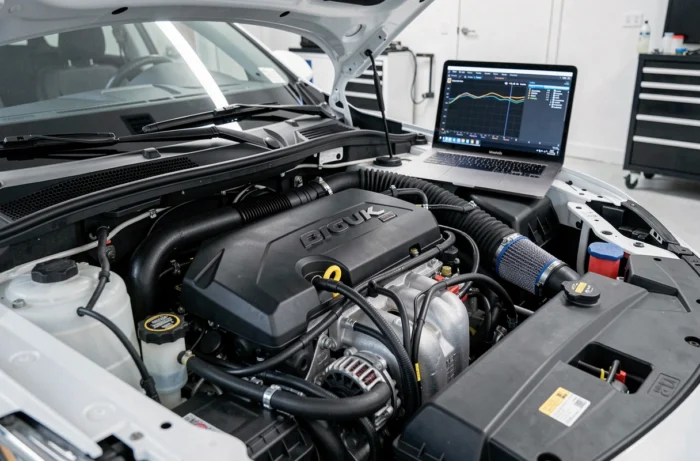
When thinking about discreet reprogramming, one imagines that the software modification remains invisible. In practice, experts appointed by insurance companies have diagnostic tools that read the event logs of the engine ECU. For serious cases (fire, total loss, bodily injury), OBD reading has become systematic.
The ECU records mapping changes, resets, and sometimes even the number of successive flashes. A trained expert quickly spots a discrepancy between the power homologated on the registration certificate (field P3) and the actual behavior of the engine. Since 2022, the ANEA has included the detection of modified mappings in its continuing education modules.
In concrete terms, if you have an incident and the expert detects an undeclared reprogramming, the case shifts. The insurer can invoke a false declaration under the Insurance Code, which opens the door to a reduction in compensation or even the nullification of the contract. This concerns a topic that directly touches on insurance and engine reprogramming at Shiftech, and feedback from drivers on forums confirms that the surprise often comes too late.
DREAL Approval and Registration Certificate: The Legal Procedure to Drive Covered
Most online discussions focus on the declaration to the insurer. This is a necessary step, but insufficient. The only legal route is through a single approval (RTI) with the DREAL, followed by an update of the registration certificate.
What the RTI Involves in Practice
The RTI involves having the DREAL verify that the modified vehicle complies with current safety and emissions standards. A technical file is submitted, the vehicle undergoes tests, and if everything is compliant, the actual power is recorded on the new registration certificate.
This process is cumbersome. It requires time, a significant cost, and most stage 1 reprogramming does not go through this step. The result: a vehicle in circulation whose actual power does not match the P3 field of the registration certificate. In the eyes of the administration and the insurer, this is a non-compliance.
Technical Inspection and Pollutant Emissions
Recent content highlights that a reprogrammed vehicle can also pose problems at the technical inspection if the pollutant emissions exceed the approved thresholds. A reprogramming that increases power often alters the combustion regime, and the values measured at the exhaust may fall outside the original tolerances.
Feedback varies on this point: some stage 1 reprogramming remains compliant at the technical inspection, while others do not, depending on the vehicle and the type of mapping applied.
Insurance Refusal Upfront: The Restrictive Trend of 2026
For a long time, risk was presented as a problem occurring at the time of the incident. The recent trend is harsher. Several sources from 2026 indicate that the majority of insurers now refuse to cover an unapproved reprogrammed vehicle, even at the time of contract subscription or renewal if the modification is declared.
The reasoning of the companies is simple: without validated RTI, the vehicle is not compliant. Assuming the risk would mean covering an asset whose declared technical characteristics are false. Some insurers specializing in modified vehicles accept the files, but the premiums are significantly higher and the conditions more restrictive.
This tightening changes the situation for drivers who hesitate between declaring or not. Not declaring exposes one to a refusal of coverage in the event of an incident. Declaring without DREAL approval exposes one to a refusal of coverage. One finds oneself in a rather narrow corridor.
Shiftech Reprogramming and Manufacturer Warranty: Two Distinct Refusals
It is important to distinguish between two mechanisms of refusal that can accumulate on the same incident.
- The manufacturer’s warranty covers manufacturing defects. If the manufacturer proves that the failure is related to the reprogramming (turbo, injectors, gearbox), they can refuse coverage. Shiftech offers a free return to stock at its centers, but this does not restore the manufacturer’s warranty once it has been canceled.
- The auto insurance covers damages related to an incident (accident, theft, fire). The refusal here does not concern the quality of the reprogramming, but the compliance of the vehicle: if the registration certificate does not reflect the actual power, the insurer contests the risk declaration.
- A third scenario concerns the resale of the vehicle: a buyer who discovers an undeclared reprogramming can invoke a hidden defect, especially if the registration certificate has not been updated.

Declaration to the Insurer Before Reprogramming: The Concrete Steps
If one decides to do things in order, the sequence is as follows:
- Contact your insurer before reprogramming to check if the contract covers modified vehicles, and under what conditions.
- Initiate the RTI procedure with the DREAL after reprogramming, providing the preparer’s technical file.
- Update the registration certificate with the new fiscal and actual power once the RTI is validated.
- Send the new registration certificate to the insurer to adjust the contract (and probably the premium).
This process remains theoretical for a large part of drivers who have opted for a stage 1. The reality on the ground is that many drive with an undeclared and unapproved reprogramming, counting on the fact that a minor incident will not trigger a thorough inspection.
The calculation holds as long as there is no major problem. In a minor material accident, the expert may not necessarily connect the OBD scanner. In the case of a bodily injury or total loss, the situation changes radically. The amount at stake determines the level of verification, and it is precisely on large amounts that non-compliance becomes a lever for refusal for the insurer.