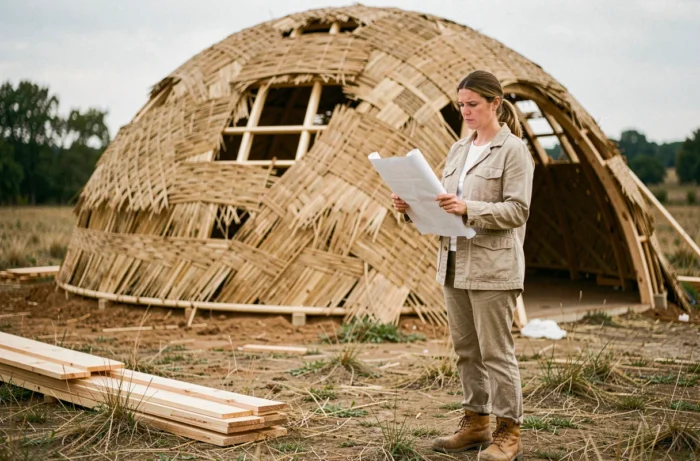
Building a kerterre on clay soil in Brittany and discovering after two winters that the walls absorb moisture from the ground: this is the kind of feedback that is regularly found among self-builders. The kerterre, this small construction made of hemp and lime popularized by Evelyne Adam, is attractive for its ecological approach and modest entry cost. However, the concrete limitations deserve attention before pouring the first mix.
Soil Nature and Stability of the Kerterre: The Neglected Factor
Most construction guides detail the hemp-lime mix or the hand-laying technique. Much less is said about the land itself. A kerterre rests directly on the ground, without heavy foundations. It works well on stable and draining soil. On land subject to shrink-swell clays, the structure can crack within a few seasons.
The risks associated with soil nature (drought, swelling clays, flood-prone areas) are documented for traditional real estate, but there is no specific regulation protecting the self-builder of a kerterre in this regard. There is no mandatory soil study or ten-year warranty as there is for a traditional house.
Before choosing a location, it is essential to consult the municipality’s natural risk cadastre. A plot exposed to groundwater rise or located in a shrink-swell clay area seriously complicates the durability of a hemp and earth habitat. Those who have delved into this subject share opinions on the disadvantages of the kerterre that confirm this on-the-ground reality.
Thermal Insulation of a Kerterre: Limited Comfort in Winter
The hemp-lime mix provides good thermal inertia in summer. The walls breathe, regulate ambient humidity, and maintain a pleasant coolness. In winter, the situation changes.
The thickness of a kerterre’s walls does not compensate for the lack of reported insulation when temperatures drop below zero for several weeks. The rounded shape limits heat loss compared to a cube, but thermal comfort remains significantly lower than that of an insulated ecological house made of straw or cellulose wadding.
In practical terms, one ends up with a habitat that requires supplementary heating, often a wood stove. The problem is that ventilating a stove in such a small volume requires particular attention. Feedback varies on this point depending on wall thickness and region, but the general observation remains the same: the kerterre is not a four-season habitat without compromise.
Maintenance of Hemp and Lime Walls: A Permanent Cycle
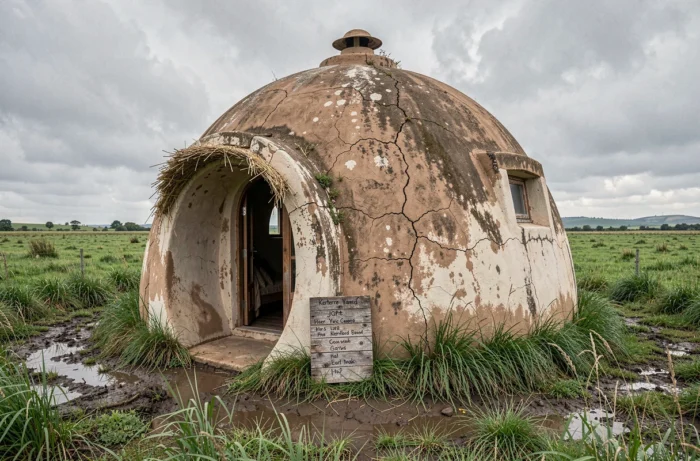
A hemp-lime render exposed to the elements degrades. Not in a few months, but monitoring must be regular. We are talking about maintenance that recurs every year or every two years, depending on exposure to wind and rain.
Recurring tasks to anticipate include:
- Partial repair of the exterior render as soon as cracks or friable areas appear, to prevent water infiltration into the hemp
- Checking the base of the walls in contact with the ground, the area most vulnerable to capillary moisture
- Preventive treatment of moss and lichens that settle on north-facing surfaces, especially in oceanic climates
- Checking the waterproofing of the green roof, which requires specific maintenance distinct from that of the walls
Maintaining a kerterre requires time and manual skills. It is not a heavy financial burden (the materials are inexpensive), but it is a regular physical commitment. Anyone considering this type of habitat must accept that construction never really stops.

Insurance and Legal Status of the Kerterre: The Administrative Void
Building a kerterre means operating within a blurry legal framework. Most kerterres do not fall into the classic categories of the urban planning code. Depending on the ground area, one may need a prior declaration of work, a building permit, or no authorization if the area remains very small.
The concrete problem arises when it comes to insuring the habitat. Finding home insurance for a kerterre is akin to an obstacle course. Traditional insurers do not have a pricing grid adapted to earth and hemp constructions. Some outright refuse coverage, while others apply surcharges or exclusions.
Coastal erosion, for example, does not fall under the regime of natural disasters and is therefore not compensated by standard home insurance. For a kerterre located in a coastal area, the financial risk in the event of a disaster rests entirely on the owner.
Resale and Heritage Value
The question of resale deserves to be asked frankly. A kerterre has almost no value in the traditional real estate market. No standardized energy performance diagnosis, no structural guarantee, no price reference per square meter. A kerterre is built to live in, rarely to constitute a resalable asset.
Living Space and Daily Life in a Kerterre
The organic shape of the kerterre imposes layout constraints that photos do not always show. The curved walls limit the placement of standard furniture. The ceiling height varies depending on the areas of the room. The actual living space is less than what the ground area might suggest.
For a single person or a couple without children, the space may be sufficient provided a minimalist lifestyle is adopted. Beyond that, the kerterre becomes a supplementary habitat rather than a primary residence: garden office, summer room, workshop. It is in these secondary uses that it finds its most solid relevance.
Connecting a kerterre to utilities (water, electricity, sanitation) adds a layer of technical and administrative complexity. Many projects operate in partial autonomy, which implies dry toilets, rainwater harvesting, and solar panels. Choices consistent with the project’s philosophy, but which effectively exclude part of the audience interested in ecological housing without wanting to give up modern comfort.
The kerterre remains a remarkable construction and living experience for those who accept its constraints. The trap would be to consider it as a classic house in a natural version. It is a demanding habitat, designed for a specific use, on suitable land, by people ready to maintain their construction over time.