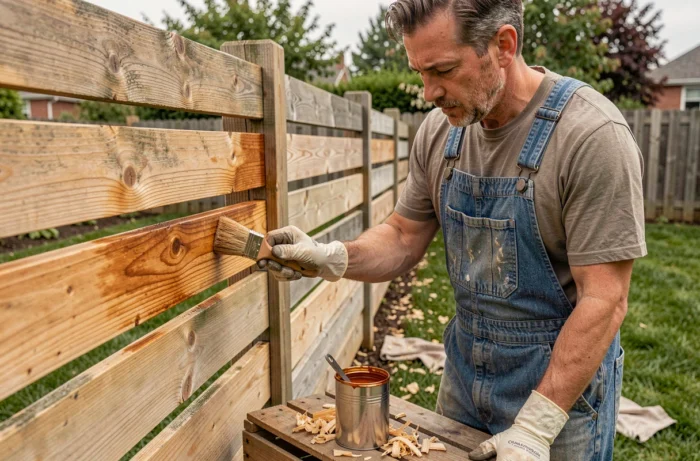
The Parkside wood stain is part of the ecosystem of tools and products distributed by Lidl, a brand that has increased its DIY references in recent years. For those looking to protect a terrace, shutters, or a garden shed, this polyurethane-based product stands out due to its significantly lower price compared to brands like V33, Bondex, or Xyladecor. The question of the relationship between this price and its actual durability over time deserves careful examination.
Parkside Stain on Exposed Exterior Wood: What Polyurethane Resin Changes
The polyurethane formulation of a stain provides a surface film that is more resistant to abrasion than a traditional alkyd stain. On paper, this translates to better resistance against freeze-thaw cycles and prolonged UV exposure. Field reports vary on this point: some users observe a satisfactory retention of color after two seasons on south-facing cladding, while others report early graying on horizontal terraces subjected to standing water.
The distinction largely depends on the orientation and exposure of the substrate. A horizontal surface endures far more stress than a vertical surface, regardless of the product applied. On a shutter or fence, the Parkside stain seems to deliver satisfactory results for its price positioning. On a terrace decking exposed full south and swept by rain, the available data do not allow for a conclusion regarding durability comparable to that of high-end stains.
To delve deeper into this topic, several resources compile tips on Parkside wood stain that detail the composition and recommended uses.
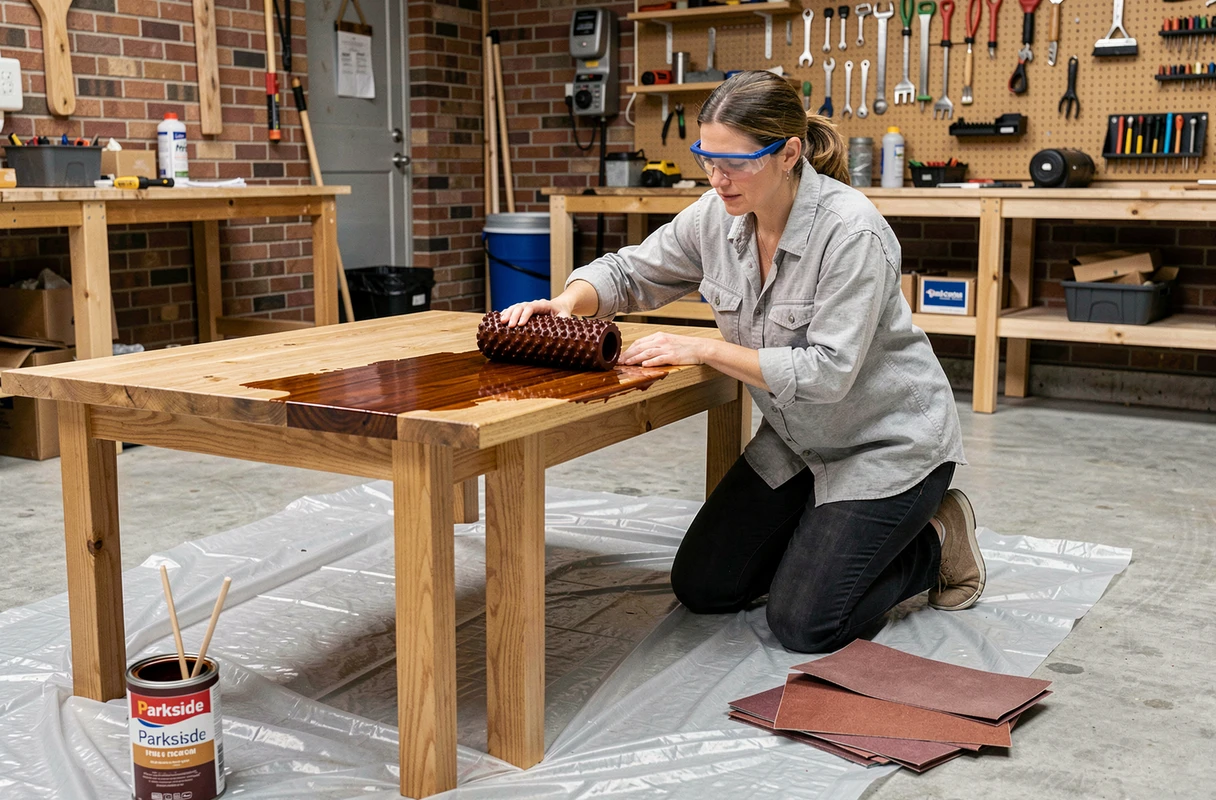
Fresh on Fresh Technique: Avoiding Visible Touch-Ups on Large Surfaces
One of the recurring criticisms of entry-level stains concerns touch-up marks, the visible demarcations between two work areas. This flaw is not unique to Parkside stain, but it manifests more easily with a product that has a short open time.
Working “fresh on fresh” in small sections remains the most reliable method to limit this issue. The principle is simple: each new pass should overlap the previous one before it begins to dry.
- Divide the surface into zones the width of one or two decking boards (or one shutter panel) and treat each zone in one go, without interruption.
- Apply the stain in the direction of the wood grain, pulling the product evenly to avoid excess at the ends.
- Prefer cooler hours (morning or late afternoon) to slow down drying and maintain a sufficient working margin.
On very absorbent wood, such as raw softwood, slightly diluting the first coat facilitates penetration and reduces the risk of saturated surface areas that will create color differences.
Light Sanding Between Coats: An Often-Neglected Step
After complete drying of the first coat, a light sanding with fine grain helps to flatten the wood fibers that have raised upon contact with the product. This sanding significantly improves the adhesion of the second coat and gives a smoother feel to the final result. Premium manufacturers’ application guides systematically recommend this, but the Parkside instructions do not always mention it explicitly.
Parkside Stain for Regular Maintenance or Heavy Renovation: Where to Draw the Line
The pricing positioning of the Parkside range naturally leans towards regular maintenance rather than long-term renovation. A refresh every two to three years on already treated wood, with a simple prior cleaning, corresponds to the scenario where this product delivers its best results.
On the other hand, a renovation on gray, flaking, or heavily degraded wood requires prior mechanical or chemical stripping, followed by a base treatment (fungicide, insecticide) before finishing. The stain alone does not restore structurally damaged wood. At this stage, the choice of finishing product weighs less than the quality of the substrate preparation.
The real decision factor can be summarized as follows: if the surface is sound and renewal is accepted at regular intervals, the Parkside stain fulfills its role. If the goal is to push the next application beyond four or five years under severe exposure, user feedback suggests turning to high-performance resin products, even if it means doubling or tripling the budget.
Preparing the Wood Before Parkside Stain: Mistakes That Reduce Durability
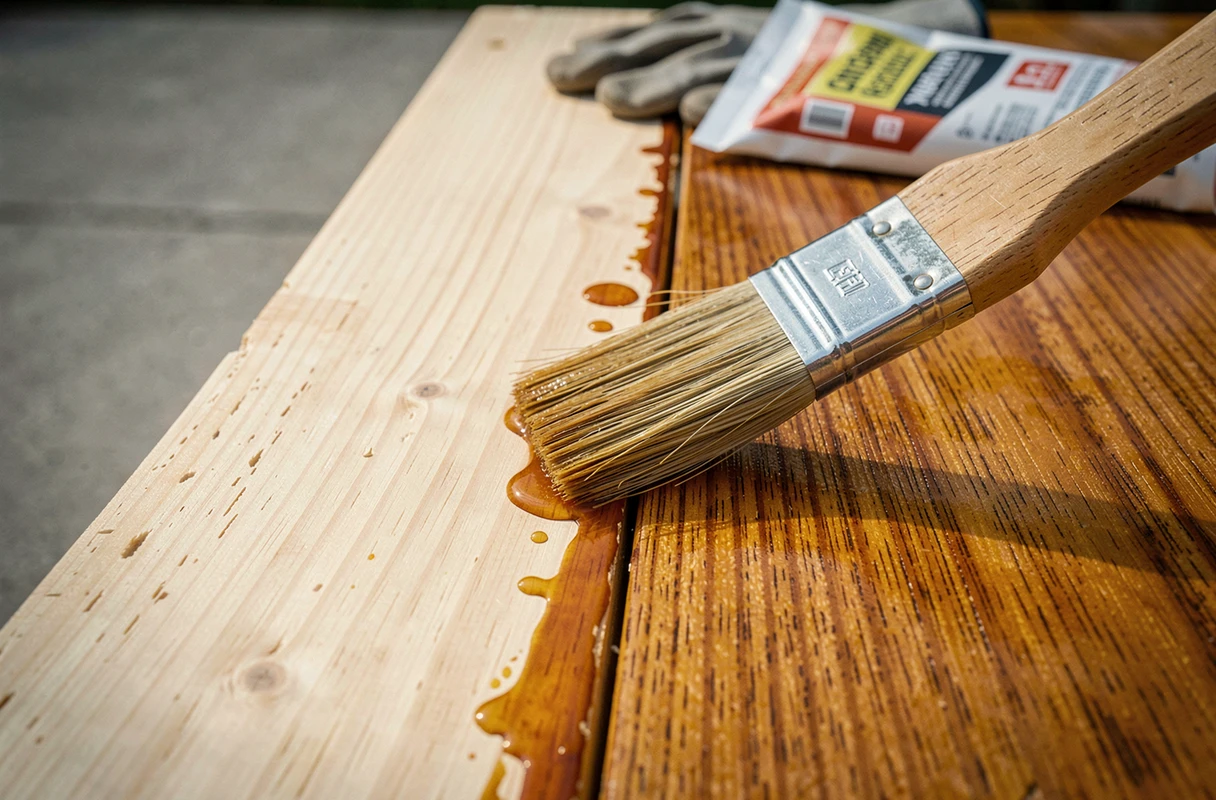
The majority of disappointments related to Parkside stain stem less from the product itself than from the preparation of the substrate. New wood often contains sawdust residues or industrial treatment agents that prevent the stain from penetrating.
- Sand new wood with medium grain, then carefully dust off before the first coat. A smooth and clean wood absorbs the stain evenly.
- Check the moisture content of the wood: a rate that is too high traps water under the stain film and causes blistering or premature peeling.
- Never apply stain on wood that is still damp after rain or on a surface exposed to direct sunlight, as rapid drying prevents proper penetration.
Well-prepared wood extends the lifespan of any stain, including an entry-level product. Conversely, even a professional stain will fail on poorly sanded or damp substrates.
Color and Final Appearance: Managing Expectations
The shades offered by Parkside remain classic (light oak, walnut, colorless). The semi-transparent finish reveals the wood grain, which is the main advantage of a stain over opaque paint. On light woods like pine or spruce, the final color may appear darker than the sample from the color chart, especially after two coats. Testing on a scrap piece of wood identical to the substrate avoids unpleasant surprises.
The Parkside stain fills a specific niche: protecting wood in good condition at a low cost, with renewal accepted at a reasonable frequency. For a terrace battered by the elements year-round, the economic calculation may reverse if frequent reapplications end up costing more than a durable product applied once. The choice depends as much on the frequency of maintenance accepted as on the initial budget.