The free nature of a virtual real estate tour tool is not measured by the displayed price, but by what it demands in return: captive hosting, watermarking, panorama compression, restriction of distribution on a single portal. Before choosing a solution, we recommend mapping these technical constraints, as they determine the actual quality of the output and the control of your data.
Data control and distribution: the true cost of a free virtual tour tool
A free software monetizes differently. Zillow 3D Home, for example, produces usable tours at no cost but confines them to the Zillow ecosystem and the North American MLS. Publishing the same tour on your own site or on a third-party French portal then requires recreating the content from scratch with another tool.
Klapty and Panoee offer broader web uses from a browser, with an embed iframe that can be integrated on any page. The difference is structural: a free embed guarantees multichannel distribution without dependency.
In practice, we observe that the question of ownership of source files is rarely raised in advance. Some free plans do not allow downloading the assembled panoramas. If you switch platforms six months later, you lose all the capture work. Always check if the export of original files is available before publishing your first tour.
To get started quickly without investing, relying on a free virtual real estate tour software remains relevant, provided you validate these portability points as soon as you create the account.
Smartphone shooting: often neglected technical settings
The majority of recent free tools accept photos taken with a smartphone, without a dedicated 360° camera. This accessibility hides a trap: the smartphone’s automatic settings degrade the visual consistency between scenes.
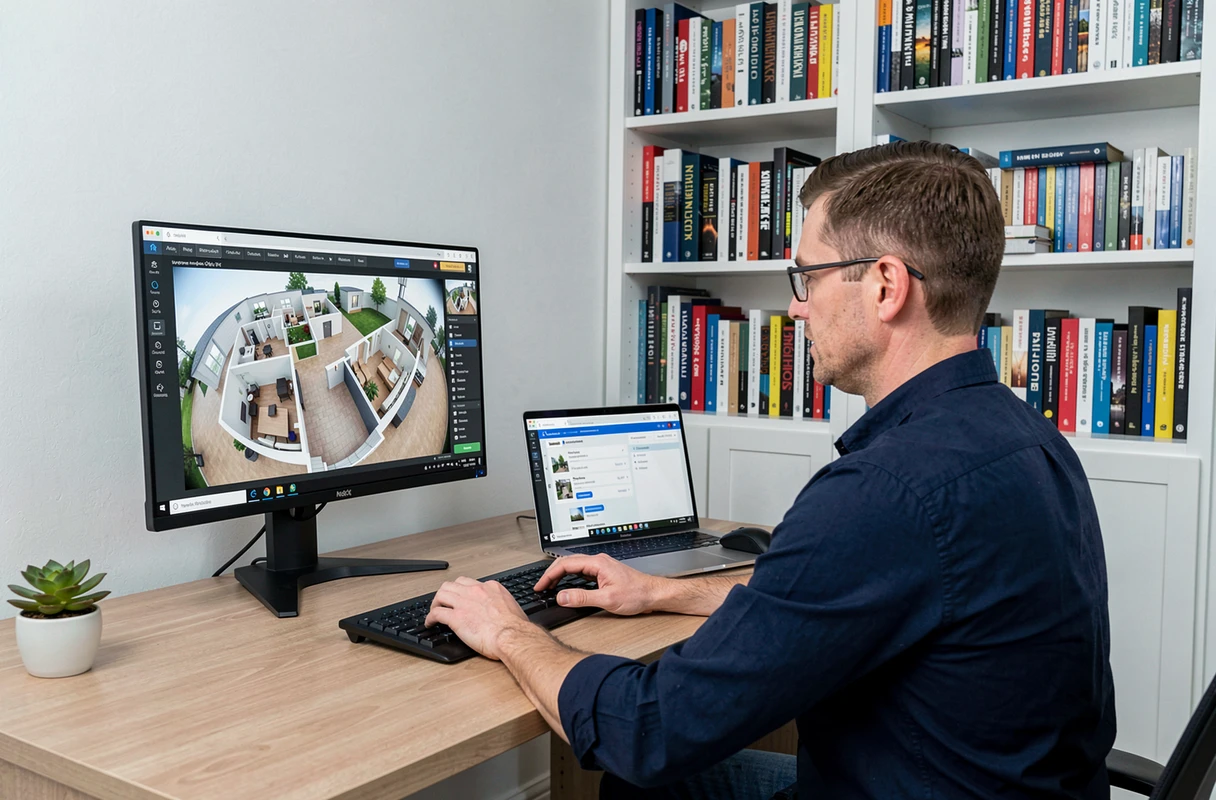
A default-enabled HDR alters the color balance from one room to another. Automatic exposure overexposes windows in a dark bedroom and then underexposes the adjacent living room. The result: a tour where each transition feels like changing properties.
Before shooting, we recommend a minimal protocol:
- Lock the exposure manually to a median value, ideally from the room that is most representative of the property in terms of brightness
- Disable automatic HDR and night mode to maintain a consistent rendering throughout the tour
- Activate airplane mode to avoid any interruptions (call, notification) that break the rotation sequence
- Free up at least several gigabytes of storage, as high-resolution panoramas quickly saturate internal memory
These settings take two minutes. They make the difference between a credible tour and an amateur assembly that the buyer leaves in seconds.
Virtual tour path: structure scenes like a real movement
The capture represents only half of the work. The ordering of scenes in the tool determines whether the visitor understands the property or gets lost in a random sequence of rooms.
Starting with the brightest or most spacious room creates a positive anchoring effect. The visitor immediately projects themselves. Conversely, opening onto a narrow hallway or a dark entrance creates a first impression that contaminates the entire tour.
We recommend limiting the number of hotspots to one or two per scene. Each hotspot should correspond to a real physical door or passage. An interactive map per floor, when the tool offers it, enhances spatial orientation and reduces the abandonment rate.
A common trap is to multiply viewpoints to impress. A tour of twelve scenes for a T3 overwhelms the buyer. Six to eight scenes are sufficient for an average-sized apartment, counting one scene per main room and an overview for open spaces.
Mobile compatibility and performance: the criterion that free plans sacrifice
The vast majority of buyers browse listings on mobile. A free tool that generates a heavy JavaScript viewer or requires downloading a third-party app loses a significant portion of the audience with the first click.
Always test the published tour on three configurations: a low-end Android smartphone, a recent iPhone, and a desktop browser. The differences in fluidity reveal the real limits of the free plan. A loading time exceeding a few seconds per scene on mobile makes the tour unusable for commercial use.
Image compression is another friction point. Some free tools reduce the resolution of panoramas to limit server-side bandwidth. The result is readable on desktop but pixelated on a Retina screen. Check the output resolution before distributing the tour on your portals.
When free costs more than a paid solution
The tipping point generally occurs with the third or fourth property published. The time spent circumventing limitations (watermark cropping, impossible export, lack of consultation statistics) exceeds the cost of a basic subscription.
Free plans generally do not offer visit analytics or tracking of time spent per scene. Without this data, it is impossible to know if the buyer saw the renovated kitchen or if they left the tour after ten seconds on the landing.
- No consultation statistics: no data to qualify the real interest of prospects
- Imposed watermark or branding: perception of a lack of professionalism among listing sellers
- Limit on the number of active visits: obligation to delete old properties to publish new ones
A free tool is suitable for testing the format and validating your clientele’s appetite. Beyond a few properties simultaneously, switching to a paid plan becomes a profitable investment, if only for the time saved on file management and multichannel distribution.
The choice of the right moment to switch depends on the volume of mandates and the frequency of publication. An agent who publishes one property per quarter can remain on a free plan for a long time. An agency with a regular flow spends more time than it saves.