
The price of McDonald’s ice creams is one of those consumption markers that spans decades. The vanilla cone, the Sundae, the McFlurry: each product has experienced its own pricing trajectory, influenced by inflation, the brand’s commercial strategy, and the geography of the restaurants. Measuring these changes allows us to understand how a dessert perceived as cheap has gradually repositioned itself.
Price Segmentation of McDonald’s Ice Creams Between Paris and the Provinces
The prices of McDonald’s ice creams are not uniform across France. The same McFlurry can cost around €4.10 in the suburbs (for example, in Limoges) and exceed €5.50 in a Parisian restaurant. In some locations considered premium, in the city center or tourist areas, the price can approach €6.70.
This gap is based on a logic of territorial segmentation. Franchisees have a margin to adjust their prices based on rent, foot traffic, and customer profile. The result: a frozen dessert whose price varies by more than 50% depending on the restaurant’s address.
Permanent recipes (Oreo, M&M’s) remain within a relatively low price range. In contrast, limited editions and seasonal recipes are systematically priced higher, with supplements of a few tens of cents and a premium range logic. A detailed overview of the prices of old McDonald’s ice creams on Ninnie En Goguette allows us to measure this evolution over several years.
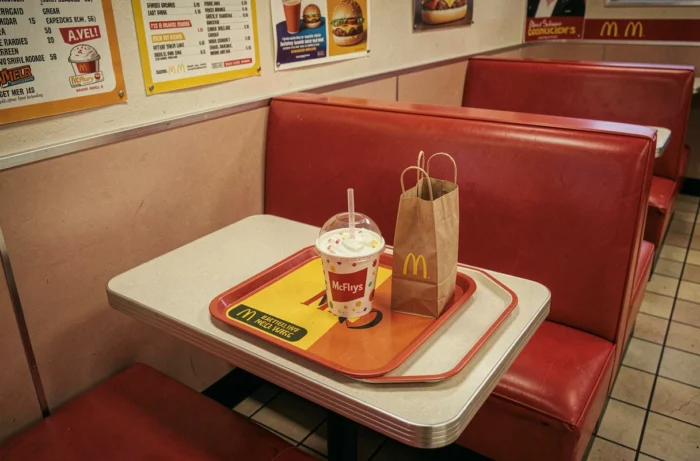
Comparative Table: Prices of McDonald’s Ice Creams by Product
The table below gathers the price ranges observed in France for the main frozen desserts on the McDonald’s menu. The differences reflect the disparity between suburban restaurants and premium urban locations.
| Product | Low Price (Suburbs) | High Price (Paris/Tourist Areas) |
|---|---|---|
| Vanilla Cone | Less than €2 | Close to €3 |
| Sundae (Caramel or Chocolate) | About €2.50 | Close to €3.50 |
| Classic McFlurry (Oreo, M&M’s) | About €4.10 | More than €5.50 |
| Limited Edition McFlurry | Slightly above the classic | Can approach €6.70 |
The vanilla cone remains the most accessible entry product on the dessert menu. The McFlurry, particularly in its seasonal variations, moves away from this entry-level logic to occupy a positioning comparable to that of a premium fast-food dessert.
Price Increase of McDonald’s Ice Creams: What the Last Decade Reveals
The McFlurry has seen a significant increase in recent years. This rise is not solely due to general food inflation. McDonald’s has publicly acknowledged that the design of its value menus has allowed franchisees to raise prices, which has resulted in alienating some of its loyal customers.
McDonald’s has admitted that its pricing mistakes have alienated its most loyal customers. The brand has notably found that certain poorly calibrated promotional offers have muddied the perception of value among consumers. This phenomenon is not limited to ice creams, but frozen desserts are a visible marker since they occupy a symbolic place in the brand’s image of accessibility.
In response, McDonald’s has rolled out several value deals in different countries to try to win back this lost clientele. The strategy involves offering fixed-price combinations that sometimes include a frozen dessert, while keeping unit prices at their current level.
Effect of Inflation on the Perception of the Vanilla Cone
The vanilla cone has long been perceived as the cheapest product on the McDonald’s menu, a mental benchmark for low prices. The gradual increase in its price, even modest in absolute terms, has a disproportionate effect on the perceived value-for-money of the entire dessert menu.
This phenomenon is amplified by consumer memory. Online discussions show that customers spontaneously compare the current price with what they paid ten or fifteen years ago, often with a margin of error related to nostalgia.
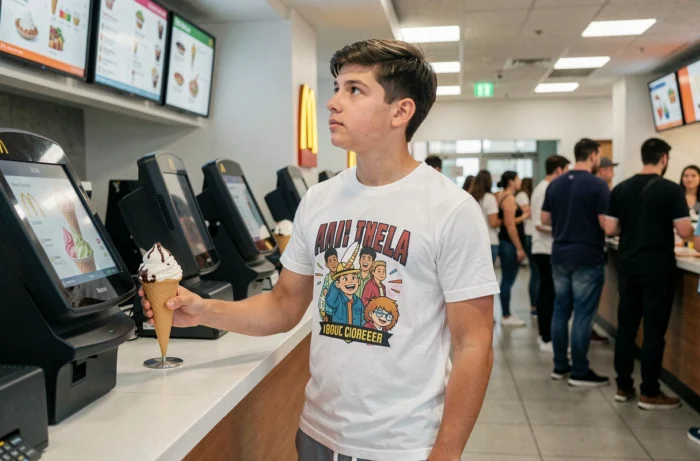
Limited Editions and Global Menu Strategy at McDonald’s
McDonald’s regularly engages in collaborations with candy brands to refresh its ice cream dessert menu. The McFlurry Toblerone, for example, illustrates this logic: a temporary recipe, a price positioning slightly above the classic, and event-based communication.
The global menu (World Menu) is another lever. McDonald’s occasionally offers recipes imported from other markets, including frozen desserts inspired by the Japanese or American menus. These products play on curiosity and the effect of rarity, two factors that justify a higher price without causing immediate rejection.
- Permanent recipes (Oreo, M&M’s) serve as a stable and familiar price base for regular customers.
- Limited editions create a sense of urgency and allow testing of higher price levels without altering the base menu.
- Imports of foreign recipes (Japanese, American menu) add a “discovery” dimension that legitimizes a premium positioning.
This constant rotation prevents any direct year-on-year comparison. The consumer no longer compares a 2024 Oreo McFlurry with a 2018 Oreo McFlurry: they compare a fleeting Toblerone McFlurry with a vague memory of a product that no longer exists in the same form.
McDonald’s and the Notion of Accessible Frozen Dessert: A Model Under Pressure
The history of McDonald’s ice cream prices tells the story of a gradual repositioning. The vanilla cone at less than €2 in the provinces maintains the image of accessibility. The limited edition McFlurry at nearly €7 in a Parisian tourist area strays considerably from this.
The gap between the entry product and the premium frozen offerings now exceeds simple to triple. This amplitude, unthinkable fifteen years ago on a fast-food menu, reflects a segmentation strategy comparable to that of traditional dining.
The frozen dessert at McDonald’s is no longer a unique product at a unique price. It is a complete range, with its entry-level, mid-range, and image products. The next limited edition will likely confirm this trend, with a price calibrated to test the upper limit of what consumers are willing to pay for a cone or cup of ice cream.