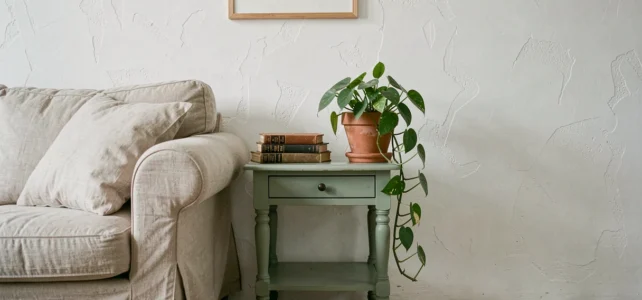
A sofa that ages poorly, white walls since moving in, a living room that looks like nothing in particular: we all know that moment when interior decoration needs a refresh. A few targeted choices on colors, materials, and volumes are enough to transform a room without buying everything new, even on a limited budget.
Trendy Color Palette 2026: What to Find in Entry-Level Ranges
The first thing to check before buying anything is the color coherence of the room. In 2026, terracotta, ochre, clay, and deep greens are gradually replacing cool grays as the base for interiors, including in affordable ranges.
Brands like Leroy Merlin are now offering warm neutrals (like Cloud Dancer off-white) and dark green or blue kitchen fronts in their budget-friendly selections. So you can follow a strong trend without a premium budget, simply by choosing a paint can well-positioned in the current palette.
The most effective approach is to start with a single accent wall in the living room or bedroom. A warm beige or greige applied to the wall behind the sofa changes the ambiance of the entire room for the price of a paint can and a roller. Specialized resources like decopascher.fr help find decor items coordinated with these new palettes without exceeding a small budget.
A common pitfall: multiplying strong colors on several walls. It’s better to have a single controlled flat color, complemented by cushions or a throw in the same color range, than three walls of different shades competing for attention.
Textiles and Decorative Objects: Levers That Change a Living Room for Less Than a Piece of Furniture
We often underestimate how much textiles structure the ambiance of a space. A new curtain, a linen cushion cover, or a well-sized rug transforms a living room more than an additional piece of furniture.
Cushions, Throws, and Curtains as Decoration Tools
When the budget is tight, start with what is most visible from the sofa. Changing cushion covers costs less than a lamp and instantly alters the room’s style. Natural materials (crumpled linen, thick cotton, boucle wool) provide a texture that cheap polyester cannot replicate.
For curtains, a solid cotton fabric in a warm color (ochre, pale terracotta) is a better replacement for tired white sheers. It adds visual warmth and coherence with the wall palette.
Rugs: Invest in the Right Size Rather Than the Right Brand
A rug that is too small under a coffee table makes the room feel narrower. The practical rule: the rug should extend at least thirty centimeters beyond the main piece of furniture on each side. A large solid rug at a low price always makes a bigger impact than a small branded rug.
Walls and Lighting: Two Overlooked Areas That Change the Perception of a Space
As mentioned, paint remains the most cost-effective lever. But beyond color, how we dress a wall and light the room determines whether the whole space feels “decorated” or simply “furnished.”
Dressing a Wall Without Expensive Frames
A composition of thrifted mirrors (three different sizes arranged in a triangle) visually enlarges a small living room and creates a focal point without buying art.
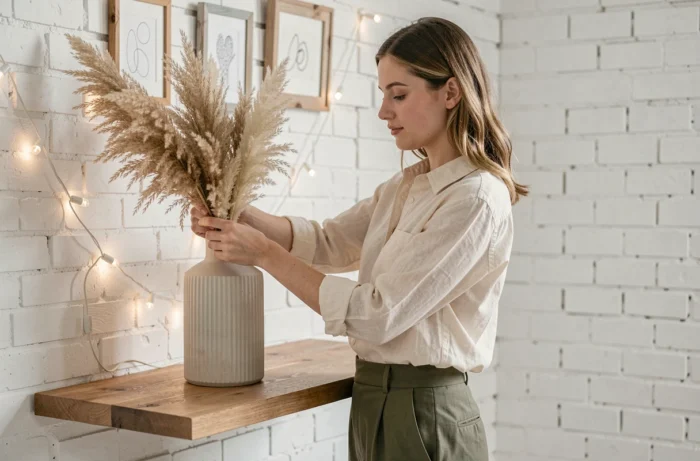
Another underestimated option: slim wall shelves. Two raw wood planks fixed to the wall can hold a few decor items (candle, small stoneware vase, book laid flat) and replace a bulky side table.
Lighting: Move Beyond a Single Ceiling Fixture
A living room lit by a single central ceiling fixture appears flat. The budget-friendly solution is to multiply low light sources:
- A lamp placed on a corner piece of furniture, with a natural material shade (rattan, jute), creates a warm light zone.
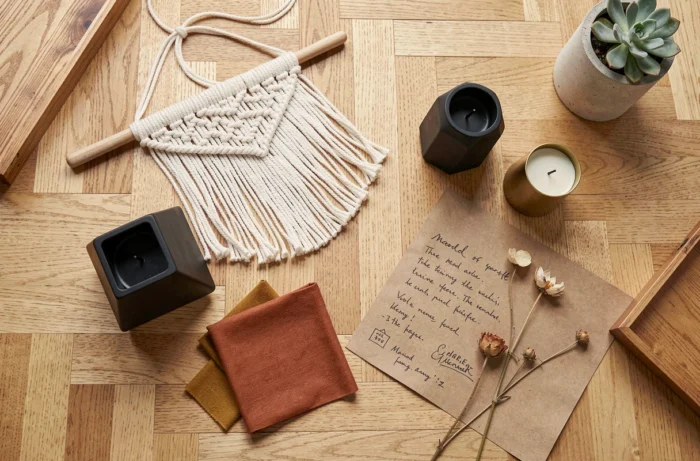
- A string of large bulb lights stretched along a shelf adds dimension without electrical installation.
- A second-hand floor lamp covered with a new shade costs a fraction of a designer light fixture and produces the same effect.
The idea is not to accumulate lamps but to create at least three light points at different heights in the main room. The ambiance shifts immediately.
Upcycling and Repurposing Objects: What Really Works in Interior Decoration
Thrifting and recycling yield good results as long as you follow a logic of color and material. Without this guiding thread, you accumulate mismatched objects that clutter more than they decorate.
- Wooden crates (from markets, garage sales) work as visible storage as long as they are sanded and stained in a single color that matches the rest of the room.
- An old wooden step ladder, cleaned and left raw, serves as a plant stand or serving cart in a corner of the living room.
- Thick glass jars (like canning jars) become vases or candle holders. Grouped in threes on a tray, they create a table centerpiece at almost no cost.
The common thread of these repurposings: group objects by material or color family. Three coordinated objects are better than ten isolated pieces. It’s the visual coherence that gives the impression of a well-designed interior, not the quantity.
Painting a thrifted piece of furniture in a shade identical to the accent wall (in a lighter or darker version) often yields a more polished result than a stark contrast. You achieve a “tone-on-tone” effect that magazines regularly use, without the budget that goes with it.
The wall palette, textiles, and repurposed objects work together. The best investment often remains a pot of paint and two hours of work on a strategic wall, complemented by matching cushion covers and two or three thrifted pieces in the same range.