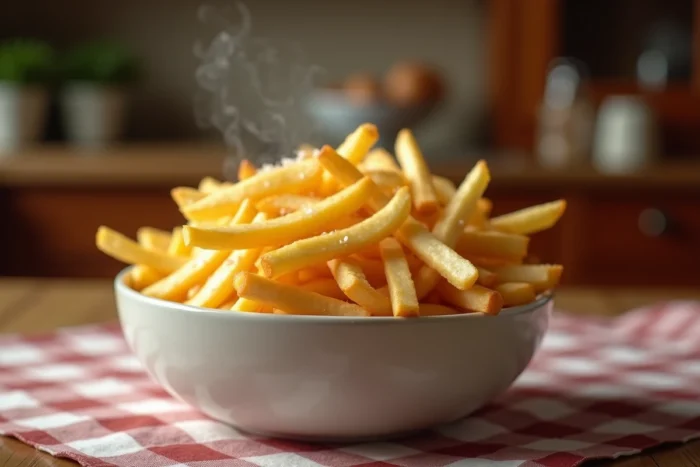
Preparing fries for several guests seems simple, until the fryer overflows or the plates remain half empty. The amount of fries per person depends on specific parameters that most recipes do not detail: the type of potatoes, the cooking method, and especially the weight loss between raw and cooked.
Weight loss during frying: the factor that no one weighs
Have you ever noticed that your bowl of raw fries turns into a much more modest portion after frying? This phenomenon has a direct impact on calculating quantities.
During cooking in oil or in the oven, fries lose a significant amount of their water. The weight after cooking represents about 70% of the raw weight. In other words, to obtain one kilogram of cooked fries, you need to start with almost one and a half kilograms of peeled and cut potatoes.
This ratio changes depending on the method. Classic frying in a bath of oil dries out more than oven cooking, where fries retain a bit more moisture. With an air fryer, the loss is somewhere in between. To know how many fries to plan per person, you should always reason in raw weight and then apply this loss coefficient.
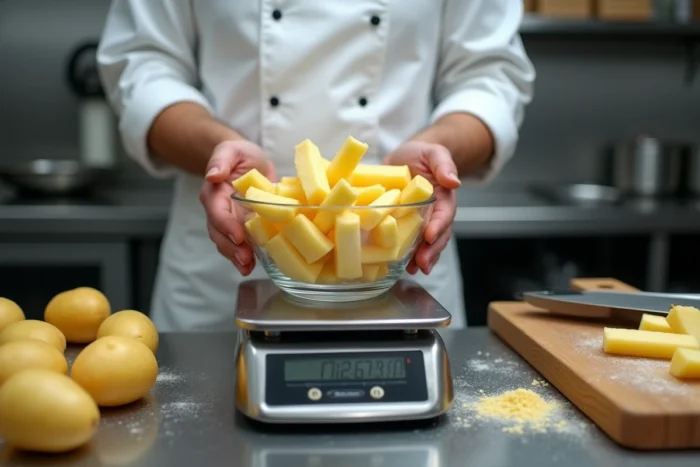
Always weigh your raw potatoes before cutting them. This is the only reliable measure. Estimating “by eye” with already cut fries almost always leads to preparing too few.
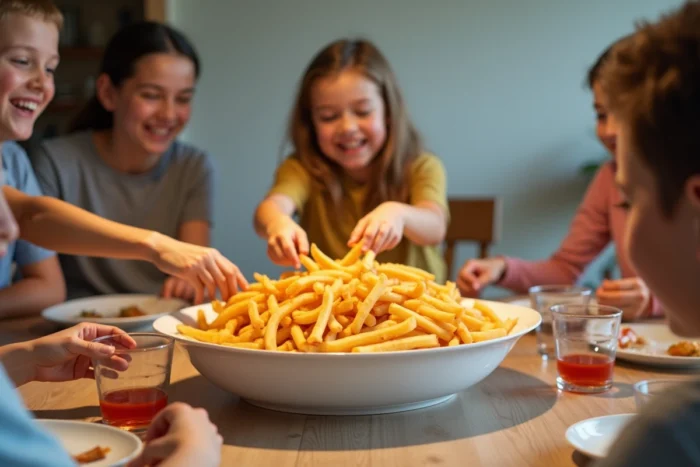
Amount of fries per person according to their role in the meal
The weight to plan is not the same if fries are the star of the meal or just a simple side dish. Here are the practical guidelines.
Fries as a main dish
When fries are the heart of the meal (moules-frites, homemade fish and chips, or simply a large dish of fries with sauces), count about 300 g of raw potatoes per adult. For children, half is more than enough.
Fries as a side dish
As a side to a steak, roast chicken, or a saucy dish, the portion decreases. Plan around 200 g of raw potatoes per adult as a side. This is enough to fill a corner of the plate without overshadowing the main dish.
Aperitif or buffet
For a buffet where fries share the table with other sides, about a hundred grams of raw fries per person is sufficient. Guests nibble, and other foods complete the meal.
Fresh fries or frozen fries: the calculation is not the same
The vast majority of fries consumed at home are frozen. This detail changes the game when weighing portions.
Frozen fries have already undergone a first frying in the factory. They are therefore partially cooked, and their water content is lower than that of a raw potato. As a result, the weight loss during the final cooking is less.
- For homemade fresh fries, start with the raw weight (peeled and cut potatoes) and apply the 70% yield ratio after cooking.
- For frozen fries, the weight indicated on the bag corresponds to a product that is already partially cooked. The weight loss during the final cooking is lower, around 10 to 15%. You can therefore reduce the starting quantity compared to fresh fries.
- For air fryer fries, cooking without a bath of oil gives a drier result. Plan the same starting quantity as for classic frying, as guests often eat a bit less (different texture).
In summary, if you serve frozen fries as a main dish, about 250 g per adult taken from the bag gives a generous portion once cooked.
Choosing the potato: waxy or floury for frying
Not all potatoes yield the same result in fries. The variety chosen influences the texture, crispiness, and even the perceived quantity on the plate.
Floury varieties (Bintje, Agria, Manon) absorb less oil and puff up more during cooking. The result: they appear more voluminous for the same starting weight. A well-cooked floury fry seems more substantial than a waxy fry.
Waxy varieties (Charlotte, Amandine) produce denser fries, creamier on the inside, but visually less generous. If you choose this type, plan for a small increase compared to usual quantities, as guests will feel they have less.
The size of the cut also plays a role. Thin fries cook faster, lose more water, and appear less abundant. Thick fries retain moisture and fill the plate better.
Summary table of quantities of fries per person
| Meal context | Raw weight per adult (fresh fries) | Weight per adult (frozen fries) |
|---|---|---|
| Main dish | 300 g | 250 g |
| Side dish | 200 g | 150 g |
| Buffet or aperitif | 100 g | 80 g |
| Child (any context) | Half of the adult portion | Half of the adult portion |
These guidelines assume a normal appetite. For a summer barbecue or a meal among friends where the atmosphere encourages second helpings, add about a quarter more to the total amount.
One last often-forgotten point: cooled fries do not reheat well. It is better to plan a little less and start a second batch if necessary, rather than throw away excess that has become soggy. Cook in two batches if your fryer or oven cannot accommodate the entire quantity, and serve hot. This is the most reliable method for a successful meal without waste.