
On a construction site or in a production workshop, a workplace accident does not give warning. When managing safety on a daily basis, the need for a structured framework becomes apparent as soon as the first narrowly avoided incident occurs. The OHSAS 18001 standard has long provided this framework for health and safety management at work. Understanding how it works remains relevant, even after its official replacement by ISO 45001.
OHSAS 18001 and ISO 45001: what the transition actually changes for your company
In workshops, we are often asked if a system built on OHSAS 18001 needs to be rebuilt from scratch. The short answer: no. The logic remains the same, that of the PDCA cycle (plan, do, check, act). What changes is the scope and the level of involvement expected from management.
The International Accreditation Forum now considers OHSAS 18001 certificates as invalid. All new health and safety certifications must go through ISO 45001:2018. Companies still certified under OHSAS 18001 can no longer renew this certificate with an accredited body.
To delve deeper into the mechanisms of this transition, one can consult the OHSAS 18001 standard with Scoopify, which details the operational steps for transitioning from one framework to another.
A revision of ISO 45001 is already underway at the ISO level, with a publication expected around 2027 and a transition period of about three years anticipated. In other words, companies migrating today to ISO 45001 will likely need to adapt their management system again around 2030. It is better to build a flexible system from the start.

Identify risks on the ground before documenting anything
The classic temptation when launching a certification project is to start with documentation. We write a policy, fill out tables, create procedures. On the ground, no one reads them.
Risk analysis must start from direct observation of workstations. Before opening a file, we move around the workshop, observe how operators handle loads, where pedestrian-vehicle circulation areas are located, and what protective equipment is actually worn.
Key points to observe during a field diagnosis
- Coactivity situations between trades or between internal teams and subcontractors, which generate the majority of unanticipated incidents
- The actual state of collective protective equipment (guardrails, extraction systems, markings) compared to what the existing documentation describes
- The gaps between written operating procedures and the actual practices of operators, often revealing constraints ignored by management
- Employee feedback on near-misses, which are rarely reported when there is no simple and non-punitive channel to signal them
This initial diagnosis directly feeds into the hazard register required by the standard. Without it, the management system relies on office assumptions.
Building a health and safety management system that lasts
We regularly see companies obtain their certification and then let the system fossilize. The quality manual gathers dust, internal audits become a formality, and the indicators no longer reflect operational reality.
An effective H&S management system is one that field teams use daily. To achieve this, a few concrete choices make a difference.
Involve management beyond just signing
ISO 45001 explicitly strengthens the role of leadership compared to OHSAS 18001. In practice, this means that management reviews can no longer be limited to an annual dashboard. Management is expected to participate in safety visits, arbitrate prevention budgets in committee, and be accountable for improvement objectives.
Feedback varies on this point: in industrial SMEs, the involvement of the leader is often natural because they are present on site. In larger organizations, the relay goes through frontline managers, who must have real decision-making authority over corrective actions.
Integrate safety processes into existing business processes
Rather than creating a parallel system, we save time and gain buy-in by grafting safety requirements onto existing processes. Risk analysis is integrated into project preparation. Non-conformity tracking joins the quality system if the company is already ISO 9001 certified. Safety indicators appear in production meetings, not in a separate meeting that no one prioritizes.
H&S certification audit: what causes companies to fail
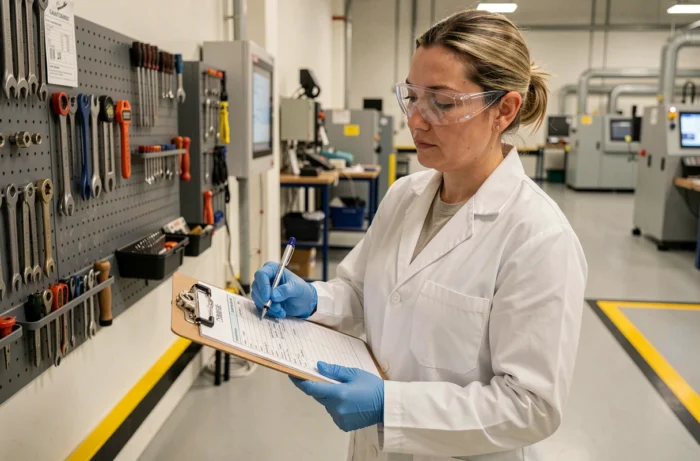
The audit is not a theoretical exam. The auditor goes on-site, interviews operators, checks the consistency between what is written and what is practiced. The most frequent discrepancies do not concern documentation, but three recurring points.
The first: the absence of evidence that corrective actions have actually been implemented. A risk has been identified, an action plan has been written, but no one can show that the guardrail has been installed or that the training has taken place.
The second: worker consultation. The standard requires that employees participate in identifying hazards and developing preventive measures. A simple annual questionnaire is not enough. The auditor looks for evidence of regular dialogue: safety meeting minutes, reports of near-misses addressed, documented improvement suggestions.
The third: the management of subcontractors and external service providers. Many companies manage the safety of their own teams well but do not integrate external workers into their system. However, accidents involving subcontractors represent a significant portion of serious incidents in industrial environments.
Sustaining the approach after certification
Obtaining the certificate is just the beginning. The real test comes during the first surveillance audit, usually one year later. At this stage, the auditor checks that the system is alive and producing measurable results.
Some concrete practices help maintain momentum:
- Schedule cross-departmental internal audits to avoid self-satisfaction and renew the perspective on risks
- Track a limited number of truly managed indicators (accident frequency rate, average time to address corrective actions, number of field reports) rather than an overwhelming dashboard
- Update the risk analysis with every significant change: new process, new equipment, reorganization of a position
The OHSAS 18001 standard laid the foundations for structured workplace safety management. ISO 45001 extends this logic with more ambitious requirements regarding leadership and worker participation. The upcoming revision expected for 2027 confirms that the framework continues to evolve. Building an adaptable system rather than a rigid one remains the best strategy to avoid starting over with each version change.