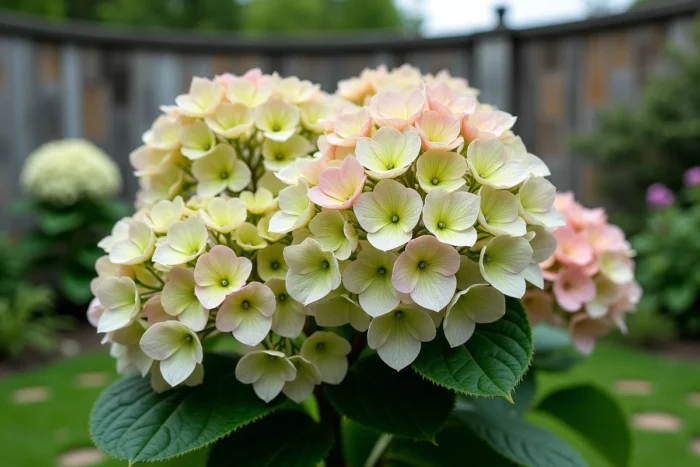
Hydrangea flowers (Hydrangea macrophylla) produce their color thanks to pigments called anthocyanins, found in the sepals. When these pigments degrade or when chlorophyll takes over in the floral tissues, the inflorescences turn green. This phenomenon has two very different timelines, and it is this distinction that guides the diagnosis.
Early or late greening: the criterion that changes everything
A hydrangea whose flowers turn green at the end of summer, after several weeks of blooming, is undergoing a normal process. The sepals, which are not true petals, gradually lose their anthocyanins as the plant redirects its energy towards seed production. Chlorophyll then reappears in these tissues, giving them a green hue.
Greening starting in June or July signals a problem. If the flowers never reached their full color before turning green, the plant is under stress that prevents the proper synthesis of pigments. Understanding the causes of a hydrangea turning green begins with this reading of the calendar.
In practice, note the date of the appearance of green. On a classic Hydrangea macrophylla that blooms in June, greening before mid-August warrants investigation. After this date, the natural cycle is sufficient to explain the change.
Iron chlorosis and calcareous soil: the duo that washes out colors
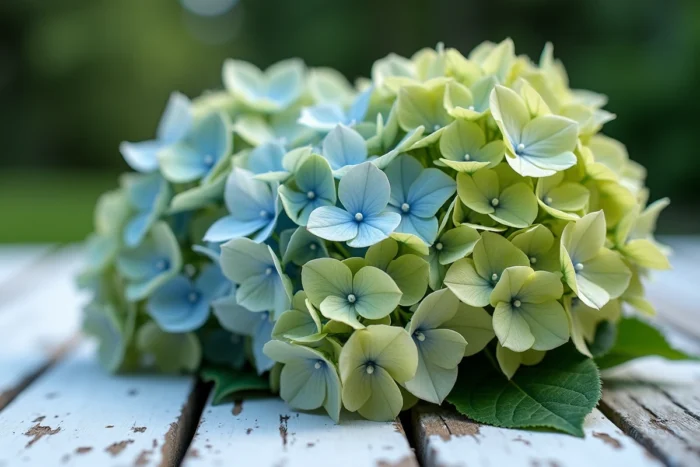
Among the causes of early greening, iron chlorosis is the most common and least understood. Iron is a cofactor in the synthesis of colored pigments in inflorescences. When it is lacking, the flowers cannot develop their pink, blue, or purple hue, and remain greenish or washed out.
The problem rarely comes from a soil that is truly poor in iron. In most cases, iron is present but blocked by a too high pH. Calcareous soil or regular watering with tap water (often high in lime) raises the pH beyond the comfort zone of the hydrangea, making iron insoluble and thus inaccessible to the roots.
Magnesium also plays a role in coloration. A combined deficiency in iron and magnesium produces inflorescences that gradually “wash out” to green, sometimes accompanied by yellowing of the foliage between the veins.
Concrete soil corrections
- Replace tap water with rainwater for watering, to limit the continuous supply of lime at the base of the plant
- Remove any gravel or calcareous mulch near the roots, as these materials release calcium with every rain and increase the soil pH
- Provide iron chelates (iron in a form that is usable even in slightly basic soil), available at garden centers under the name “anti-chlorosis”
- Use a specific hydrangea fertilizer, formulated to maintain acidic soil and provide iron and magnesium in suitable proportions
These corrections do not produce an immediate effect on already open flowers. Ongoing inflorescences will not regain their original color. The goal is to prepare for the next blooming.
Water stress and exposure: two aggravating factors
The hydrangea is a woodland plant. Prolonged direct sunlight degrades anthocyanins much faster than partial shade. Gardeners who observe rapid greening on a hydrangea recently moved to full sun often have their explanation.
Water stress amplifies the phenomenon. A hydrangea that lacks water closes its stomata, slows its photosynthesis, and the plant enters survival mode. The production of floral pigments, which is energy-intensive, takes a back seat. The sepals turn green because chlorophyll, which is less costly to maintain, takes over.
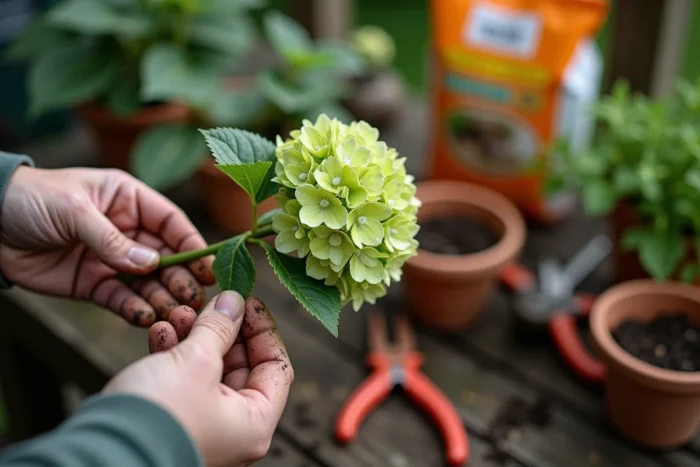
Conversely, a permanent excess of water (saturated soil, constantly full saucer for potted hydrangeas) causes the beginning of root asphyxiation. Damaged roots poorly absorb iron and trace elements, which aligns with the chlorosis mechanism described above.
Adjusting the environment
An acidic mulch (pine bark, conifer needles) at the base of the hydrangea serves three simultaneous functions: it maintains soil moisture, limits evaporation during hot periods, and slightly acidifies the substrate as it decomposes. For potted hydrangeas, a location receiving morning sun but protected during the hottest hours yields the best results.
Frequent confusion between greening and color change related to pH
Many guides mix two distinct phenomena. The soil pH modifies the color of Hydrangea macrophylla between pink (neutral to basic soil) and blue (acidic soil rich in available alumina). This mechanism has nothing to do with greening.
Acidifying a soil will not correct a green hydrangea. Adding aluminum sulfate, for example, will shift the color towards blue if the plant is already producing anthocyanins. But if the problem is a lack of iron, water stress, or simply the end of the cycle, changing the pH alone will not alter the green.
This distinction is fundamental to avoid treating the wrong problem. A green hydrangea needs its ability to produce pigments restored (iron, magnesium, proper hydration, suitable exposure), not a modification of the hue of pigments that no longer exist.
White varieties like ‘Annabelle’ (Hydrangea arborescens) are a special case. Their flowers naturally transition from white to lime green at the end of the season, without indicating any problem. This greening is even sought after by some gardeners for creating dry bouquets with autumn hues.
A hydrangea whose flowers turn green mid-season deserves a methodical examination: date of appearance, soil type, quality of watering water, exposure. The answer is almost always found in one of these four parameters, and rarely in a single treatment.