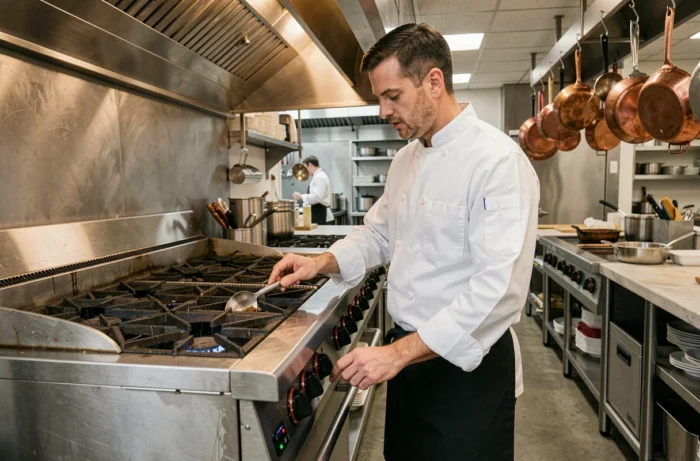
A professional kitchen equipment is defined by its ability to maintain a continuous production rhythm while adhering to the applicable health and safety standards for establishments open to the public. The choice of each appliance commits the restaurant for several years, both financially and regulatory-wise. Two often overlooked criteria at the time of purchase, air extraction and refrigerant fluid, condition the compliance and durability of the installation.
Extraction and ventilation: the technical prerequisite before any cooking purchase
Most equipment guides start with the oven or the plancha. In practice, the first parameter to check concerns the extraction system. In France, when the total useful power of cooking appliances exceeds 20 kW, the kitchen falls under the regulations for large kitchens in establishments open to the public.
This threshold triggers specific obligations: dedicated exhaust duct, supply of fresh air compensating for the extracted volume, and sometimes permissions from the landlord or the co-ownership. Ignoring this constraint before ordering a stove or a combi oven exposes one to unexpected work, or even to a refusal of compliance during the safety commission inspection.
The logical approach is to have an extraction diagnosis performed before sizing the cooking line. A restaurateur who selects their appliances based on their power in kW, then a hood and an air handling system afterwards, risks having to reduce the installed power or undertake heavy ductwork.
Several suppliers now offer a catalog covering both cooking equipment and associated ventilation solutions, as can be seen on https://equipotto.fr/, which simplifies the technical coherence of the project.
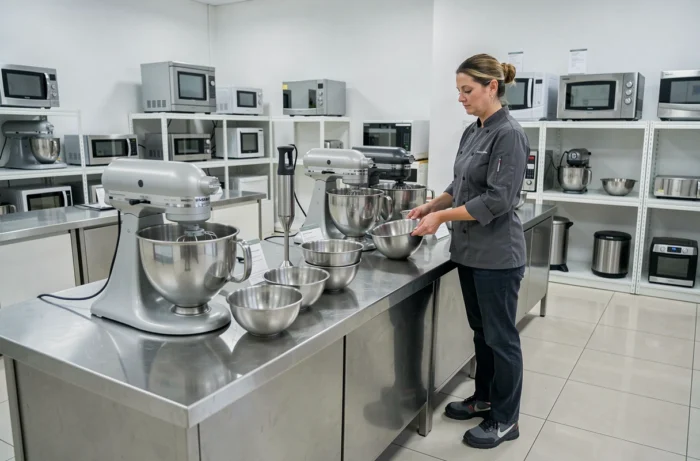
Refrigerants and F-Gas regulation: choosing sustainable cooling
The European regulation (EU) 2024/573, which came into effect on March 11, 2024, accelerates the reduction of fluorinated refrigerants. For a restaurant, this means that the choice of a refrigerated cabinet or cold room also commits to the future availability of the fluid used.
An appliance operating with a fluid that has a high global warming potential will gradually become more expensive to maintain, as the production quotas for these gases decrease year after year. Conversely, devices using natural fluids (propane R-290, for example) or low-impact climate HFOs offer better visibility in the medium term.
What to check before signing
- The type of refrigerant indicated on the technical data sheet, and its classification in the F-Gas reduction schedule
- The supplier’s or service provider’s ability to ensure maintenance on this fluid in your geographical area
- The actual electrical consumption of the device, as efficient cooling reduces the energy bill, a significant expense for a restaurant
The usual reflex is to compare purchase prices. Including the maintenance cost of the fluid over five to ten years often changes the ranking of offers.
Maintainability of professional kitchen equipment: a direct purchasing criterion
A device that is difficult to disassemble, clean, or calibrate weakens the sanitary control plan of the establishment. Good food safety practices include technical maintenance and regular calibration of control devices, particularly thermometers and scales.
When selecting an oven, a cooling cell, or a professional dishwasher, three questions should be asked of the manufacturer:
- Are the filters, seals, and probes accessible without specific tools, or is a certified technician required for each intervention?
- Are spare parts guaranteed to be available for a defined period after purchase?
- Does the manufacturer offer a maintenance contract that includes the calibration of temperature sensors?
Equipment that is cheaper to purchase but requires technical intervention for each deep cleaning generates hidden costs and service interruptions. The ease of maintenance protects both profitability and sanitary compliance.
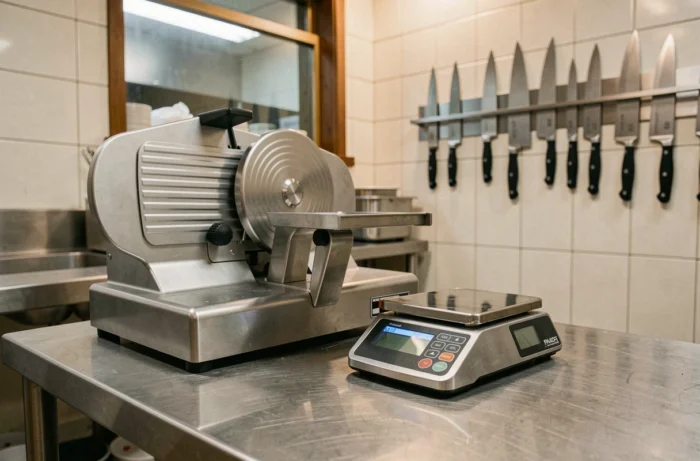
Sizing restaurant equipment according to space and workflow
The production volume and available surface area determine the size of the appliances, as well as their layout. A professional kitchen operates in zones: receiving goods, cold storage, preparation, cooking, plating, dishwashing. Each zone corresponds to a workflow that must not cross dirty circuits.
A compact combi oven will suit a small capacity restaurant, while an establishment serving several hundred covers per service will need stackable modular appliances or continuous cooking lines. Measuring the floor space and ceiling height before any order avoids costly returns and last-minute adjustments.
The common mistake regarding the dishwashing area
Many restaurant creators underestimate the professional dishwasher. A device that is too slow creates a bottleneck during service, forces the storage of dirty dishes in the preparation area, and compromises hygiene. The basket throughput per hour must correspond to the number of covers served during peak activity, not the daily average.
Choosing restaurant equipment is not just about comparing product sheets. Compliance with extraction, the sustainability of the refrigerant fluid, ease of maintenance, and suitability for workflow are four technical parameters that determine the viability of the investment far beyond the initial purchase price.