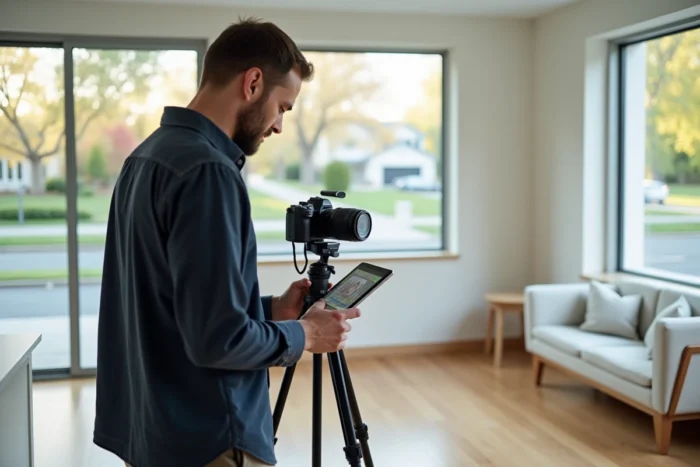
A real estate agent orders a virtual tour for a three-room apartment in the city center. The provider delivers a Matterport rendering with 3D modeling, scaled plans, and interactive hotspots. The invoice far exceeds the planned budget. The problem does not stem from the base rate, but from options added without checking their actual usefulness for this type of property. This scenario often repeats itself, and most of the extra costs are avoidable in advance.
Extra costs related to unreported virtual home staging
The item that discreetly inflates the bill is the virtual home staging added to the quote without prior consideration. Furniture is replaced, decoration is added, and wall colors are changed. The rendering is appealing, but two problems arise immediately.
The first is legal. Several sources remind us that virtual home staging must be disclosed as such and must not hide a defect of the property. Altering the reality of a property without clear mention exposes the seller and the agent to disputes during the physical revisit.
The second is financial. For a vacant apartment, virtual home staging can be justified to help buyers envision the space. For a furnished property in good condition, one pays for a service that neither improves the qualification of prospects nor the perception of the sale price. Before validating this option, one can check the prices of lamaison360 on Immovalys to compare what each package actually covers.

Premium virtual tour or lightweight solution: how to decide based on the property
Not all houses and apartments deserve the same level of service. This is the point that most sellers and agents overlook when preparing the quote.
Properties where premium is justified
A house with land, atypical volumes, or a complex layout truly benefits from a complete 3D tour with spatial modeling. Potential buyers, especially those searching from a distance, use the virtual tour to filter out properties that do not meet their volume criteria before visiting. For this type of property, investing in professional-quality capture with smooth navigation between rooms has a direct impact on the qualification of contacts.
Properties where a lightweight solution is sufficient
For a rental studio, a standard two-room apartment, or a property intended for rental investment, a tour with 360° panoramic photos without 3D modeling serves the same purpose. Buyers or renters in this segment seek to verify the general condition, brightness, and layout of the rooms. They do not need a scaled plan down to the centimeter.
- Character house, atypical property, new program with a show house: complete 3D tour with hotspots and plans, the extra cost is recouped in better-qualified physical visits.
- Standard apartment for sale or rent in a common building: simple 360° panoramas, possibly generated with an AI solution or a consumer camera.
- Vacant property requiring projection: targeted virtual home staging focused on the main living areas, not on every corner of the property.
The choice of the package depends on the type of property, not the overall marketing budget. Applying the same service to an entire portfolio amounts to overpaying for simple properties and under-investing in complex ones.
Preparation errors that increase the cost of capture
The price of a virtual tour often includes the time spent on-site. Each additional intervention by the photographer or technician is billed, either directly or through an inflated package. Three preparation errors consistently recur.
The first: not tidying up and cleaning before the capture. A 360° tour shows everything, including cables on the floor, laundry on chairs, and cluttered countertops. If the technician has to wait or return, the cost increases. On this point, feedback varies by provider, but the majority charge an additional travel fee if the property is not ready.
The second: poorly managed lighting. Closed curtains on the south side, lights off in rooms without windows, harsh backlighting. The technician compensates in post-production (HDR correction, retouching), which increases processing time and thus the final bill.
The third: not defining the capture perimeter. Should the garage, basement, and garden be included from three different angles? Each additional room or space adds capture and processing time. Deciding in advance which areas add real value to the real estate listing helps avoid paying for panoramas that no one will view.
Distribution and mobile compatibility: the invisible extra cost
A technically accomplished virtual tour that is poorly distributed does not generate qualified visits. And a tour not optimized for mobile loses a significant share of potential buyers, who check real estate listings from their phones.
Some premium solutions produce large files that slow down loading on smartphones. The prospect leaves the listing before even seeing the first room. One has then paid for a high-end service that does not fulfill its commercial function.
Before signing a quote, three concrete points should be checked:
- Is the output format compatible with the main real estate listing portals (iframe integration or direct link)?
- Does the loading time on mobile remain under a few seconds, even on 4G?
- Does navigation work with a finger on a touchscreen, without plugins or dedicated applications?
If the answer is no to any of these points, the extra cost of a premium solution does not translate into commercial results. It is better to have a lighter solution, perfectly distributable, than a spectacular rendering stuck in a proprietary format.
The price of a virtual house tour depends less on the displayed rate than on the decisions made in advance. Choosing the right package according to the type of property, preparing the property before capture, and checking distribution compatibility are enough to avoid most extra costs. The goal remains the same: to qualify buyers before the physical visit, not to produce immersive content that no one loads to the end.