
The Norwegian fjords are narrow arms of the sea, carved by glaciers to depths of several hundred meters, where saltwater mixes with freshwater from rivers and snowmelt. This geological configuration creates very particular swimming conditions: low temperatures even in summer, localized currents at the mouths, and water quality that varies depending on proximity to port or urban areas.
Water Temperature and Thermocline in the Norwegian Fjords
The depth of the fjords produces a marked phenomenon of thermal stratification. At the surface, the water warms up under the effect of the summer sun, while just a few meters below, the temperature drops sharply. This thermocline explains the sudden cold sensation felt by swimmers who immerse themselves beyond waist-deep.
In summer, the surface layer reaches very variable values depending on the fjord, sunlight, and latitude. The southern and western fjords (Sognefjord, Hardangerfjord) generally have milder water than those in the north. The national weather app Yr, used daily by Norwegians, now provides near real-time surface temperatures, allowing for the right moment to take the plunge.
Preparing your body for swimming in the fjords of Norway starts with gradual acclimatization: entering slowly, wetting the neck and wrists, and limiting the first immersions to a few minutes.
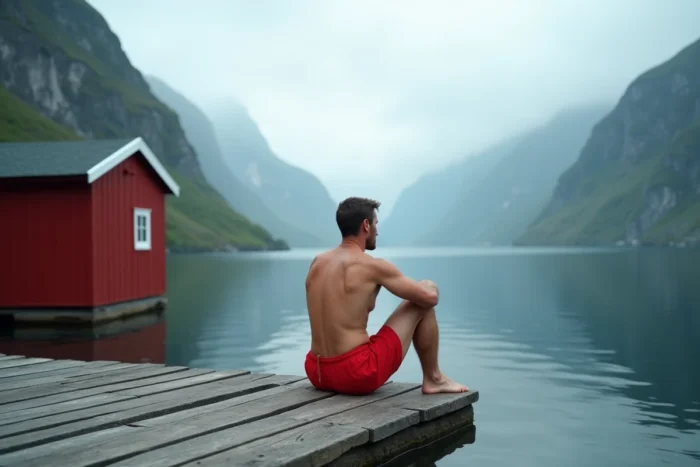
Sognefjord, Nærøyfjord, Geirangerfjord: Where is the Water Accessible?
Not all fjords are equally suited for swimming. Access to the water depends on the relief of the shores, boating traffic, and the presence of minimal infrastructure (docks, pebble beaches, ladders).
The Sognefjord, the longest and deepest in Norway, offers isolated coves accessible on foot from certain villages. However, its size implies more sensitive currents at the mouth. The Nærøyfjord, a narrow branch of the Sognefjord classified as a World Heritage site, charms with its calm waters framed by cliffs, but the practical entry points remain limited.
The Geirangerfjord primarily attracts visitors for its mountain landscapes and waterfalls. Tourist navigation is dense during peak season, which reduces safe areas for swimming freely. Locals prefer secluded bays, away from ferry routes.
Urban Fjords: Oslofjord and Bergen Bays
The Oslofjord and the waters around Bergen represent a special case. These urban fjords benefit from regular monitoring of water quality by the municipalities. After heavy rains, contamination alerts may be issued, particularly in areas close to ports. Checking municipal bulletins before swimming in these areas helps avoid unpleasant surprises.
Since recent heatwaves, residents of these cities have been using the fjords as a daily thermal refuge, prompting authorities to increase the frequency of bacteriological checks.
Equipment and Physical Preparation for Swimming in Cold Water
Swimming in a fjord does not require diving equipment, but a few items make the difference between an enjoyable experience and giving up after thirty seconds.
- A wetsuit of at least three millimeters thick protects against thermal shock and extends swimming time. Without a wetsuit, most swimmers can only last a few minutes in the northern fjords.
- Neoprene booties prevent cuts from rocks and pebbles, which are very common at natural access points. Some shores are covered with mussels whose shells are sharp.
- A silicone or neoprene swim cap limits heat loss through the head, which represents a significant part of overall thermal loss.
- A swim buoy (inflatable, brightly colored) ensures visibility to boats and provides floating support in case of cramps.
Physical preparation is not just about cardio fitness. Acclimatization to the cold is developed over several days, gradually increasing immersion time. Experienced cold-water swimmers recommend never swimming alone and always informing someone on land.
Safety in the Fjord: Currents, Navigation, and Specific Risks
Fjords are not lakes. Their direct connection to the sea generates tidal currents, sometimes reinforced by wind that rushes between the rocky walls. These currents are rarely violent in the inner branches but can surprise at the narrow passages between two basins.
Maritime traffic is the most underestimated risk. Ferries, cruise ships, and tourist kayaks share the same waters. A swimmer at the surface is not very visible from a boat, especially in overcast weather or at the end of the day when low light makes detection difficult.
- Stay within fifty meters of the shore to limit exposure to traffic.
- Avoid ferry crossing areas, identifiable on local nautical charts or by observing regular routes.
- Do not swim near waterfalls that flow into the fjord: they create underwater turbulence and suddenly cool the surrounding water.
Norwegian authorities remind everyone of water safety rules every summer, with particular attention to foreign visitors who may be less accustomed to local conditions. Drowning remains the leading cause of accidental death in summer in the country, which justifies a cautious approach even for good swimmers.
Best Time and Weather Conditions for Swimming in the Fjords
The swimming window without a wetsuit (for the most resilient) is concentrated between late June and mid-August, when prolonged sunlight warms the surface layer. Beyond the Arctic Circle, the midnight sun offers swimming slots in the evening with sufficient brightness, but the water remains colder than in the south.
Calm and sunny days are ideal. Wind amplifies the cold sensation when exiting the water and can create uncomfortable chop in wide fjords. The Sognefjord or Hardangerfjord, oriented east-west, are more exposed to prevailing winds than narrow branches like the Nærøyfjord.
Checking the weather on Yr the day before and the morning of remains the most reliable reflex. Conditions change quickly in the narrow fjords, where mountains create local microclimates capable of transforming a bright morning into a rainy afternoon in less than an hour.